
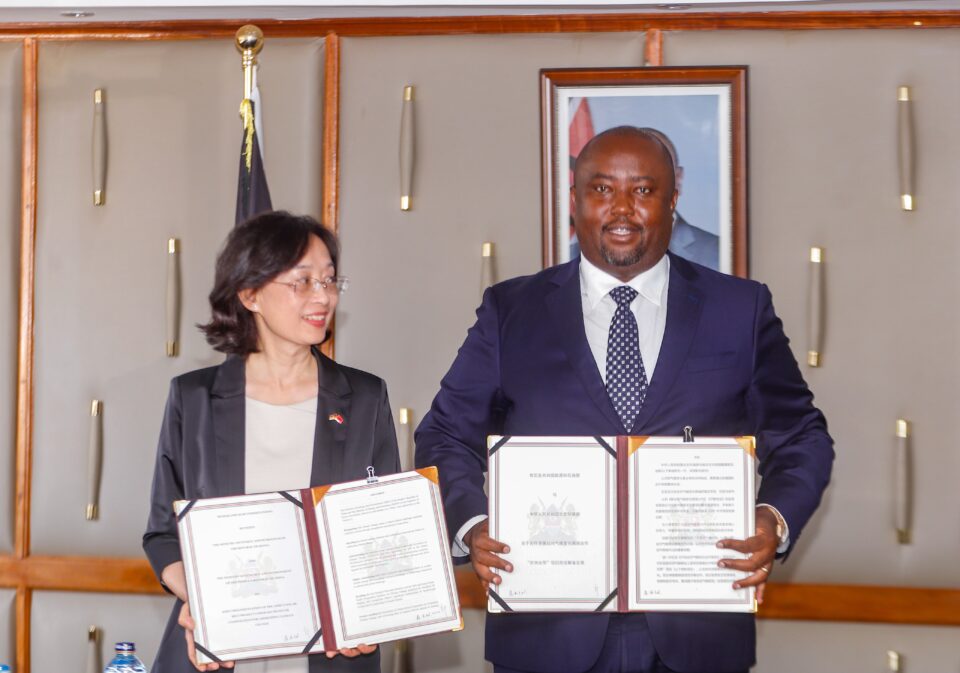
Kenya is set to expand access to electricity in underserved rural communities through an international clean-energy partnership with China that will establish 80 off-grid solar power systems to support schools, health facilities and water supply services.
The initiative, known as the Africa Solar Belt Project, is expected to target communities where limited access to reliable electricity continues to constrain the delivery of essential public services.
The project follows the signing of a Memorandum of Understanding between Kenya’s Ministry of Energy and Petroleum with China’s Ecology and Environment ministry at the Kawi Complex in Nairobi.
This marks another step in the two countries’ cooperation on climate change and renewable energy.
“The Africa Solar Belt Project aligns with the government’s goals for equitable service delivery, decentralized renewable power generation, and community-level climate resilience,” Energy and Petroleum Principal Secretary (PS), Alex Wachira pointed out.
Under the MOU, the solar infrastructure will support digital learning networks, improve classroom environments, and aid the delivery of essential education services in academic institutions.
“The initial potential sites identified for these decentralized solar networks include Kilifi County, Tana River County, and Maasai Mara University,” the PS revealed, noting that beyond schools, the installations will prioritize health clinics and community water supply systems to enhance clean energy access in far-flung areas.
Potential project sites include Tana River and Kilifi counties, as well as Maasai Mara University.
Under the arrangement, the 80 solar photovoltaic installations will provide decentralised electricity to facilities in remote areas, with schools, water supply systems and health clinics identified among the intended beneficiaries.
For schools, Wachira highlighted that reliable electricity is expected to improve learning environments, support digital education and strengthen the delivery of essential educational services.
“Health facilities could also benefit from more dependable power for basic medical services, while solar-powered water systems would help strengthen access to water in communities beyond the reach of reliable electricity infrastructure,” the PS noted.
The project, according to Wachira is particularly significant for remote communities where extending conventional electricity infrastructure can be challenging.
The United Nations Children’s Fund (UNICEF) is supporting the initiative through matching funds, resources and technical expertise, reinforcing its focus on improving conditions for children and vulnerable communities.
The partnership builds on China’s Ten-Hundred-Thousand Initiative and the Belt and Road South-South Cooperation Initiative on Climate Change, which seek to strengthen international collaboration on climate action and low-carbon development.
For Kenya, the initiative aligns with Vision 2030 and other economic development frameworks particularly the commitment to expand access to essential services, promoting inclusive development and strengthening community resilience.
However, the long-term impact of the installations will depend not only on their construction but also on effective management, maintenance and continuity of operations, the PS noted.
The government has emphasised the need for close coordination between the two countries, UNICEF and other stakeholders to ensure the systems remain operational and sustainable beyond the initial implementation period.
Despite progress in the last mile electricity connectivity, critical power access gaps persist in Kenya’s coastal counties of Tana River and Kilifi. Data from the 2023/24 Kenya Housing Survey shows that only 40.1 per cent of households in Tana River and 35.7 per cent in Kilifi were connected to the national electricity grid, against a national average of 58.1 per cent. The reliance on solar-charged batteries for household lighting, reported by 49.5 per cent of households in Tana River and 37.2 per cent in Kilifi, further illustrates the potential for decentralised renewable energy solutions.
