
By Milliam Murigi
African researchers must move away from science conducted purely for academic discovery and focus on generating evidence and solutions that address challenges facing the continent.
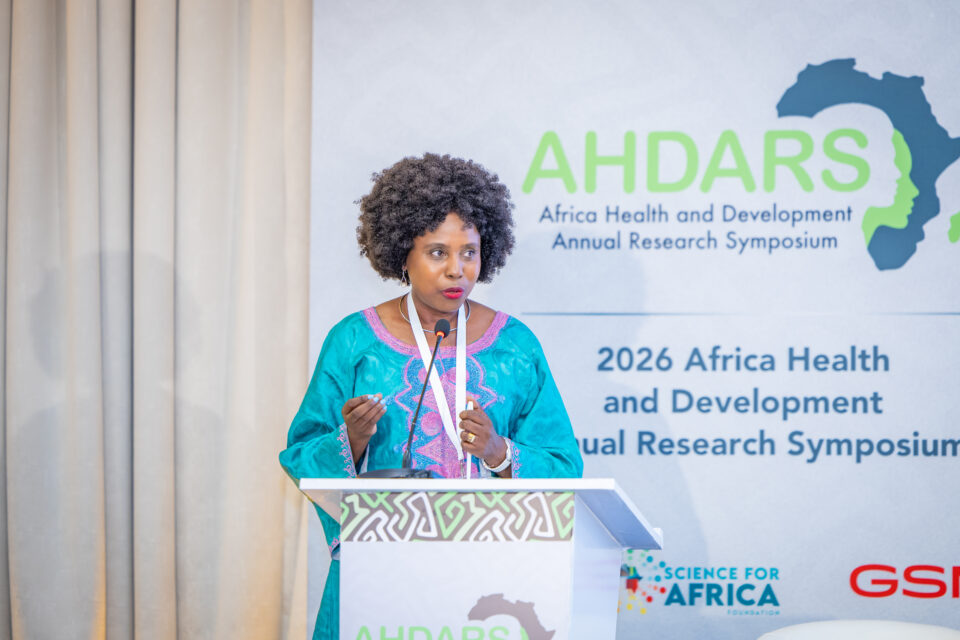
This was revealed during the third Africa Health and Development Annual Research Symposium (AHDARS 2026), which brought together researchers, practitioners, innovators and policymakers to discuss how African-centred data and knowledge systems can be strengthened.
Speaking during the meeting, Dr. Catherine Kyobutungi, Executive Director of the African Population and Health Research Center (APHRC), said that research should be driven by the need to solve everyday challenges facing African communities rather than scientific discovery alone.
“The era of doing science for discovery’s sake, and doing science for knowledge’s sake, and doing science that doesn’t really solve any problems on the African continent should be over,” she said.
The symposium, themed “Building African-Centered Data and Knowledge Systems: New Models, New Power. What Can Be Done Differently?”, examined Africa’s position in the global knowledge system and the need for the continent to have greater ownership and control over its research data.
According to Kyobutungi, for many years, African data and knowledge systems have largely been controlled outside the continent, leaving African researchers with limited influence over how information generated from their populations is analysed and used.
“We can’t keep operating in the same system where Africa’s data is owned and controlled and analysed and used outside the continent,” she said.
She warned that when African communities do not own the knowledge informing development programmes, the resulting interventions risk overlooking their lived experiences and actual needs.
Data and research, she said, are essential in developing solutions across several sectors, including healthcare, agriculture, climate change and infrastructure.
Speaking at the same event, Prof. Tom Kariuki, Chief Executive Officer, Science for Africa (SFA) Foundation, echoed the concerns, warning that Africa risks reproducing historical inequalities in the digital economy if it fails to take ownership of its data and knowledge systems.
“Global research systems have historically sidelined African scientists, despite the continent being a major source of data used in scientific studies. Data is usually collected here and analysed elsewhere. Therefore, the ownership is transferred without our consent, and it is monetised to the benefits elsewhere,” he said.
Kariuki warned that the rapid expansion of AI and big data could deepen these inequalities unless African institutions deliberately change how research data is governed, shared and analysed.
He outlined three shifts needed to strengthen Africa’s position: moving from data extraction to data sovereignty, from access to an African-led open research ecosystem and from donor-led evidence generation to African-owned knowledge systems.
On data sovereignty, Kariuki clarified that African ownership should not mean restricting access to information or creating closed data systems. Instead, African institutions should determine the conditions under which their data is shared, accessed and used.
“Open means, or must mean, open on African terms,” he said.
He also called for an African-led open research ecosystem in which researchers on the continent are not merely granted access to global research platforms but have the authority to shape research priorities and lead scientific analysis.
Kariuki said the African Union, working with partners including the SFA Foundation, was advancing discussions on an African-led open research policy expected to be launched in Egypt in January 2027.
The proposed initiative, he said, should align with the continent’s wider development ambitions, including Agenda 2063 and its aspirations for technological advancement, innovation and scientific development.
He further argued that African governments need locally generated and timely research evidence to inform policy decisions, particularly in healthcare, where advances in precision and personalised medicine depend on relevant population data.
“Policymakers need evidence, and they need evidence that is local, that is provided timely, that is actually trusted for them to sit and push it into policy very quickly,” he said.
However, turning research data into practical solutions will also require closer collaboration between researchers, governments and private-sector technology companies.
Kanwulia Okafor, Director of Industry Services, Africa, at the GSMA, said no single institution or sector could independently address the challenges facing Africa’s data and evidence ecosystem.
“Data ecosystem faces challenges including fragmented information, varying data quality and uneven technical capabilities. That is why no single actor can work on this data and evidence alone. Stakeholders must work together rather than operate in isolated sectors,” she said.
Okafor said the mobile industry could play an important role because mobile operators provide digital infrastructure that enables data and evidence to be transformed into services that people can use.
Describing the mobile ecosystem as the digital infrastructure provider, she said it could help turn collected data and research evidence into useful digital services that improve decision-making and outcomes for African communities.
“For GSMA, our priority is to ensure that digital technologies go beyond technological development and instead transform lives and improve decisions affecting Africans,” said Okafor.
She challenged participants to consider their individual contributions to the data ecosystem, whether as researchers, government representatives or private-sector players and identify ways of connecting their respective roles.
