
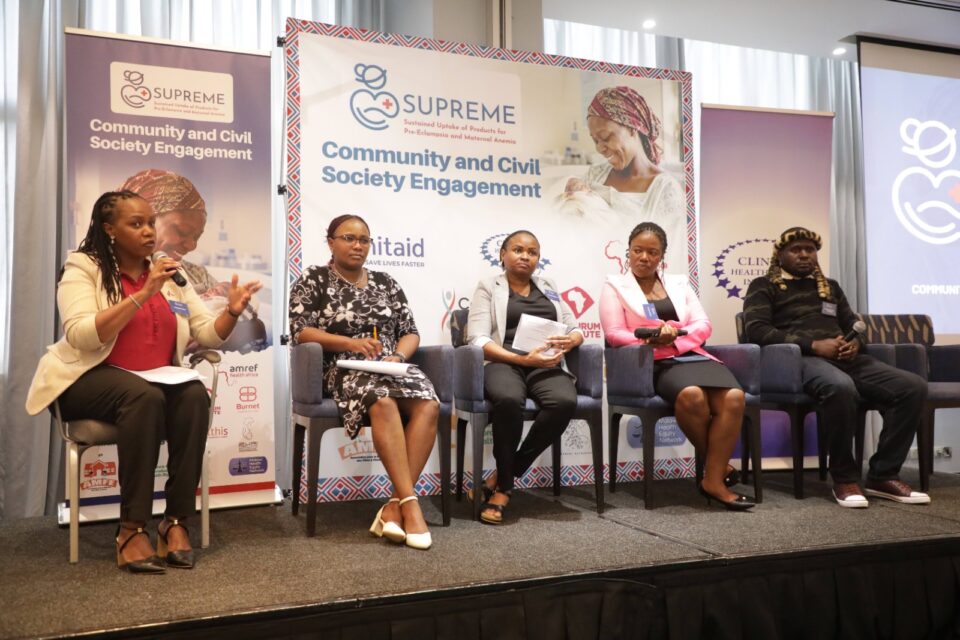
Ruth Wangari knows the joy of carrying a pregnancy. She also knows the pain of losing one.
Twice, pregnancy ended in loss.
When she became pregnant again, the difference was not simply that her body responded differently. This time, she had access to medicines and interventions that helped her navigate the pregnancy.
She survived, her baby as well.
But Wangari knows that what helped her through pregnancy is not necessarily available to every woman.
“I think I made it through my journey because I was privileged to be able to afford some of these, maybe like the medications,” she told a gathering discussing the experiences of women affected by pre-eclampsia and other complications of pregnancy.
Her use of the word “privileged” is telling.
For many women, surviving pregnancy can depend on whether they can pay for a scan, buy a medicine when a public facility runs out, find transport to a referral hospital or recognise that a headache or swollen feet may be more than an ordinary discomfort of pregnancy.
For others, it can come down to whether a health worker listens when they say something is wrong.
Across Kenya, Tanzania, Ghana and Malawi, women and community representatives shared stories that brought those vulnerabilities into sharp focus.
Their testimonies formed a human face around the challenge that maternal-health programmes are trying to address, including pre-eclampsia and maternal anaemia, which are still major threats to women and newborns, even though tools to detect and manage many of these complications already exist.
The SUPREME initiative is working across African countries to improve access to those interventions and strengthen the health systems that deliver them.
But behind every intervention is a woman.
And behind every statistic is a family.
Wangari’s story is important because she does not describe herself simply as a victim of a difficult health system, but a survivor.
“I found the medicines and care I needed, but my experience made me acutely aware of the women who cannot,” she told a gathering hosted by WACI Jeslth in Nairobi.
For a pregnant woman struggling financially, antenatal care can become a series of difficult calculations, it was rrvealed in the same forum.
Can she afford the scan, transport, and if she is prescribed a medicine that is unavailable at the facility, can she buy it elsewhere?
These are some of the questions that emerged during a panel discussion, including , if the woman can return for another appointment.
One of the speakers at the meeting described the cost of ultrasound scans as a particular barrier, noting that some women delay antenatal visits because they fear being asked to pay for services they cannot afford.
“Some women also believe that if they feel well, there is no reason to attend a clinic early in pregnancy,” Rosemary Mburu., the Executive Director of WACI Health, a regional advocacy organization
championing the end of life-threatening epidemics and improved health outcomes.
She revealed that oher women take advice from friends or relatives who tell them to wait until the pregnancy begins to show.
“However, by the time a woman feels seriously ill, the window for simple intervention may have narrowed, ” she added
Wangari’s survival therefore sits uneasily beside the stories of women who did not have the same options.
Catherine Kakolo Mongella, a pre-eclampsia survivor, Founder and Chief Executive Officer, Thrive Beyond
Preeclampsia Foundation, lost a daughter after surviving her son
In Tanzania, Mongella carries a different kind of memory.
“My first pregnancy was complicated by pre-eclampsia,” she said, revealing that .she gave birth to a son prematurely at 27 weeks, weighing about 1.5 kilogrammes, but the baby boy survived. Today, he is 13.
The survival, she pointed out, might have made the next pregnancy seem less frightening, but instead, it became another battle.
At 32 weeks, she developed pre-eclampsia again. Her feet were swollen. She battled a series of severe headaches. But those symptoms were treated as ordinary features of pregnancy.
“You have swollen feet. That’s normal. You have a headache. Every pregnant woman has a headache,” she recalled being told, with a stillborn pregnancy.
Mongella found herself dealing with two realities at once: mourning her baby while fighting for her own life.
“I literally was fighting for my life while grieving the loss of my daughter,” she said.
Her story is a reminder that danger signs do not always announce themselves, which the audience valodated.
Sometimes they look like an ordinary headache.
Sometimes they look like swollen feet.
And sometimes a woman needs someone to stop and ask whether what she is experiencing is actually normal.
Dr Ofosua Ehla came into pregnancy with knowledge many women do not have. She knew her family history.
Her mother had experienced pre-eclampsia. Her sister had experienced it repeatedly.
A Clinical Pharmacist by background, when Dr. Ehla became pregnant, she took precautions.
“I monitored myself, sought care, yet pregnancy still took me into dangerous territory,” the global health advocate, and Member of the Ghana Community
Advisory Board, testified.
At about eight months pregnant, protein was detected and she eventually underwent an emergency Caesarean section, but the danger did not end with delivery.
She explained that her feet became increasingly swollen and she developed postpartum problems associated with pre-eclampsia.
Then came another frightening episode.
“During a ward round, I noticed that a blood-pressure reading being communicated to the doctor was wrong. At least I knew enough to question it.
“The reading was checked again and the error was discovered,” she said.
Her story illustrates something often missing from discussions about maternal health, where women are not merely recipients of care, but also observers of their own bodies.
They notice changes, and ask questions, and sometimes, their insistence can become an additional safety net, noted Mburu.
But Dr. Ehla also encountered another problem—access to medicine.
“At one point, an antihypertensive I needed was unavailable, forcing my family to search elsewhere even though I was receiving care at a major hospital,” she recalled.
Her experience exposed the uncomfortable gap between having a health facility and having everything a woman needs when she gets there.
In Malawi, Chief William Jalavikuba Munthali, also recognized as Inkosi Jalavikuba II, brought the conversation out of the hospital and into the community.
His sister’s pregnancy ended in tragedy.
Severe weather and flooding complicated the family’s efforts to get her to better-equipped care.
The baby was born prematurely and placed under nursery care, but died after about 24 hours.
“The loss was devastating, however, it also exposed a bigger problem on what happens to women living far from functioning referral systems.
He spoke about poor roads, delays in reaching hospitals, shortages of medicines and equipment, and the difficulties rural families face when emergencies occur.
In communities where household incomes are low, even being told to buy a medicine from a private pharmacy can be an impossible demand.
“A woman who is already critically ill can become even more vulnerable,” Chief William said, oting that noting that the road to the hospital becomes part of the medical emergency.
One speaker described the experience of a woman who goes to a facility for antenatal care only to feel that she is being treated poorly or ignored.
For a first-time mother, that experience can be enough to discourage her from returning.
Pregnancy already carries fear and uncertainty.
When a woman feels that her concerns do not matter, the health facility can become somewhere she avoids rather than somewhere she seeks help.
The SUPREME work includes a community and civil-society component intended to put people with lived experience closer to decisions about maternal-health interventions.
WACI Health says its community engagement work has involved women and affected communities in shaping how lifesaving diagnostics and treatments are developed and delivered.
Back to the testimonies. Wangari survived two pregnancy losses and eventually experienced a successful one, while Mongella survived pre-eclampsia but lost her daughter.
Dr. Ehla on the other hand survived a pregnancy complicated by pre-eclampsia and discovered that knowledge can sometimes be a woman’s strongest defence.
In Malawi, a family lost a premature baby while facing the realities of distance, weather and referral challenges.
Their stories are different, but they converge on one uncomfortable truth, a pregnancy can be medically complicated, but the outcome is shaped by much more than biology.
