
For years, Kenya’s debt debate has largely been measured in trillions of shillings — how much the country owes, how much it borrows and how much it spends servicing the debt.
But Alexander Riithi, a public finance and budget analyst says the more difficult question lies somewhere else on what happens when a government begins spending money on the assumption that revenues will come in, only to discover later that the money is not there.
That, he argues, is where Kenya’s debt problem begins.
According to Riithi, the Head of Programs at the Institute of Social Accountability (TISA), the country’s budget-making process starts with revenue projections that are often not achieved. When the expected money fails to materialise, the Government is forced to borrow to finance expenditure that has already been incurred.
“Whenever we have revenue shortfalls, that forces us to increase our debt appetite for us to cover for the expenditures that we have incurred,” he said during an editors’ forum in Nairobi.
He warned that the problem is compounded by rising expenditure and shrinking access to international borrowing, pushing the Government increasingly towards the domestic market.
The consequence, he said, is that the State increasingly competes with businesses for available credit — a situation that can crowd out private-sector borrowing.
Statistics at the National Treasury highlights the pressure. The Public Debt Management Office (PDMO) reported total public debt of Sh12.32 trillion as of March 2026, equivalent to 65.7 per cent of the GDP, against a 55 percent debt anchor, with domestic debt accounting for Sh6.78 trillion.
Riithi, however, says the answer cannot simply be to find new ways of borrowing.
“We should first of all start by having the right forecasts for all our macroeconomic indicators, especially our GDP number, our revenues, and have a credible budget,” he said.
He also wants expenditure brought under control.
“How do we reduce our expenditure and what do we do with our economy to ensure that we are generating more than what we are?” he posed.
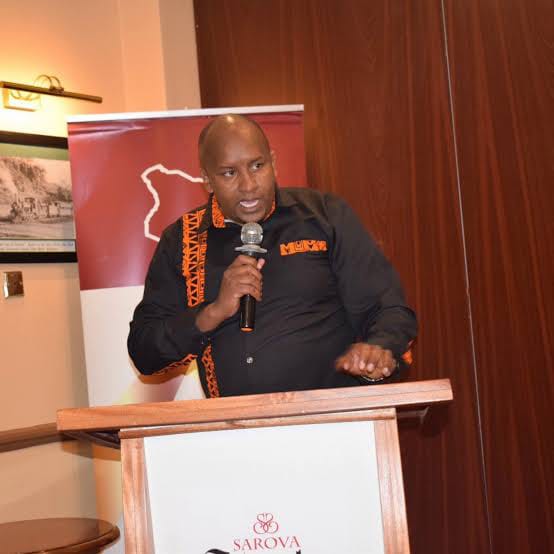
Riithi was speaking during the Kenya Editors Guild (KEG) and the International Republican Institute (IRI) peer-to-peer engagement series on media agenda-setting on complex and high-risk public financing issue.
The budget that changes after approval
And for Riithi, the problem is not only the size of the budget but also whether the budget approved by Parliament remains the budget that government actually implements.
He pointed to spending authorised under Article 223 of the Constitution, saying that as much as Sh209 billion was added to the budget during the last financial year.
“That means our budget credibility from what was formulated to how we spent, is off the table,” he said.
Article 223 allows expenditure to be incurred from the Consolidated Fund where money has not been appropriated by Parliament, subject to constitutional conditions and subsequent parliamentary approval.
Consequently, he argues that tighter control of such additional expenditure is therefore part of restoring credibility to the budgeting process.
His prescription starts with the size of government.
“In my view, the starting point is reducing the size of our government,” he said, noting that once the size of our government is reduced, automatically overhead costs are cut down.
He also referred to proposals to rationalise the number of state corporations, arguing that reducing duplication could help lower recurrent costs.
The broader concern is one that Treasury itself has recognized that Kenya is pursuing fiscal consolidation aimed at moderating debt growth, improving revenue collection and eprioriti and eprioritizing expenditure.
When tomorrow’s revenue is spent today
However, his warning is about securitisation of debts, emphasizing that this takes the conversation around this issue into a less familiar territory.
Securitisation allows future revenue streams to be used to raise money today.
Riithi says the danger is that the public may not fully understand the commitments being created until they begin affecting the cost of living.
“The one big challenge with securitization currently is the fact that it is being done in very opaque circumstances,” he said.
“There is no public participation, nobody knows about securization until it comes to your bill.”
He cited the securitisation of the fuel levy as an example, saying it added Sh7 per litre to the levy.
But his larger argument is clear that when future revenue is committed to repay today’s borrowing, a future administration inherits obligations over which it had no role in making the original decision.
“We are utilizing future revenues today,” he pointed out.
In his view, that can constrain future governments because revenue that might otherwise have been available for new priorities has already been committed to debt repayment.
Who gets to see the agreements?
Again, Riithi says Kenyans need to know the terms under which future revenues are being committed.
“We should have regulation of how do we securitize, how do we ensure that there is adequate public participation in the same,” he said.
He also called for the agreements themselves to be made available.
“Right now, all of us are just arguing about the securitized revenue streams. Nobody has seen those agreements.”
Among the questions he says should be answered are how long the commitments will run, what contingent liabilities they contain and what happens if the Government defaults.
Those questions go beyond the immediate politics of debt.
They concern the extent to which today’s fiscal decisions constrain tomorrow’s choices.
The burden passed forward
Treasury has described Kenya’s public debt as sustainable but at high risk of debt distress, while maintaining a fiscal-consolidation strategy intended to reduce vulnerabilities.
Alex argues that moving further away from the debt anchor would create additional room for borrowing without necessarily solving the underlying imbalance between revenue and expenditure.
He favours returning to fiscal consolidation rather than continually expanding the borrowing space.
“We should be trying as much as possible through fiscal consolidation to come down and actually reach 55 percent of the GDP,” he said.
For him, the issue is ultimately about intergenerational fairness.
The Constitution, he noted, provides for equity between present and future generations.
His concern is that by committing future revenues to debts raised today, Kenya risks leaving future governments with less room to decide how those revenues should be used.
“We are robbing future generations of revenues that they would have planned on how to utilize them,” he said.
