
An estimated 17 million children have been vaccinated against typhoid through the United Nations in Kenya’s financial and technical assistance in the last five years.
During the period in review, the UN in Kenya also reached over half a million adolescent girls with sexual and reproductive health services, including supporting vaccination of 5 million children against measles and rubella.
Dr. Stephen Jackson, the outgoing UN resident coordinator in Kenya kicked off his tour of duty in March 2021, and during his time in the country, close to 9 million people received food assistance and nutrition support, with a focus on those in Arid and Semi-Arid Lands (ASALs) who are continually exposed to climate-induced food insecurity.
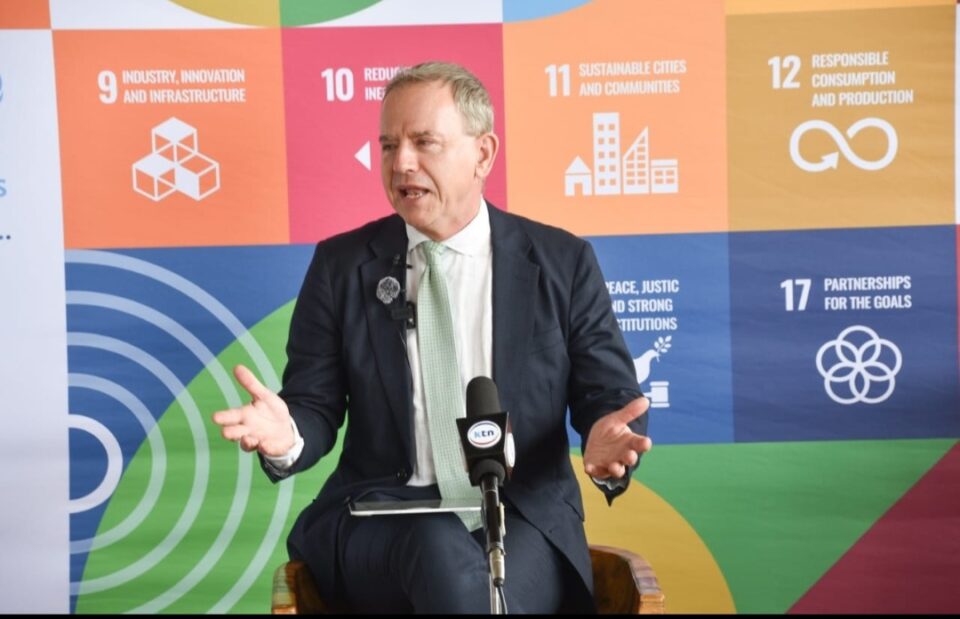
“And as I move to be resident coordinator for the United Nations in China, I really just wanted an opportunity to say thank you to Kenya, for five extraordinary years in which I think the United Nations in Kenya has gone from strength to strength,” Dr. Jackson said in a sitting with journalists who cover UN operations in the country.
Taking stock of the half decade of tour of duty in Kenya, he stated that during that time, the UN in Kenya has been able to do some great things for the country.
Dr. Garry Conille has taken over from Dr. Jackson and will come into office on April 1 after serving in the Pacific island nations of Jamaica, Bermuda, Bahamas, and Turks and Caicos for the same period.
“It’s been an immense privilege to be here as the head of the United Nations development system for Kenya for these five years during which we also reached 2.4 million people through the Inua Jamii Cash- Based social protection Programme,” he said.
His tour of duty saw many other positives including reaching an estimated 2 million people with skills, education and wellbeing programmes.
About 1 million people, he revealed, gained access to safe water in programmes also that saw strengthening of the food security situation.
“An estimated 197,780 farmers have been supported with climate-smart technologies and interventions. This marked a shift from short-term yields to durable systemic change,” he added.
Through the United Nations Sustainable Development Cooperation Framework (UNSCDF) 2022-2026, Dr. Jackson led a radical shift from fragmented, project-based work to joined-up, large-scale programming across 25 UN agencies that operate in the country.
The Irish born diplomat – who first arrived in the country 40 years ago as a young man – credits this paradigm shift to the delivery of over Sh322.5 billion (US$2.5 billion) in support aligned to Kenya’s national development priorities.
“We were able to establish a model of collective delivery rather than isolated interventions, and witnessed more than 20 joint programmes scaled and driving real impact delivered across sectors,” he highlighted, outlining some specific examples.
The water joint programme with the national and county governments for instance reached over 1 million people in the Arid and Semi Arid Lands (ASALs) with climate-resilient water solutions.
This also resulted in the promotion of a sustainable school feeding programme that linked farmers to schools and supported the country’s ambition to reach 10 million children.
“I am delighted to point out that through this joint programme, the UN in Kenya, reached close to 1 million young women under the Adolescent Health Development Impact Bond,” Dr. Jackson said, pointing out this innovative Development Impact Bond for Adolescent Sexual and Reproductive Health, deploying an App and performance-based financing, has already provided essential information and services to almost 1m young Kenyan women.
It’s during his tenure that Kenya’s first UN country-level SDG Multi Partner Trust Fund was established bringing together 4 bilateral donor partners and re-invested at an estimated Sh5 billion (US$35m).
Through Dr. Jackson’s leadership, Kenya has been able to negotiate an innovative Sh129 billion (US$1 billion) Debt-For-Food-Security Swap, signalling the way forward on climate-related development financing.
In 2025 alone, despite the global financing cuts, the UN Kenya office mobilised approximately Sh59.3 billion (US$460 million) in expenditures.
“The results reflect the collective work of 28 UN entities supporting Kenya under the UN Sustainable Development Cooperation Framework (2022–2027), and a strong partnership anchored in national priorities,” the outgoing envoy described these outcomes, noting they support Kenya’s Vision 2030, and progress across the SDGs.
As Dr. Conille enters the UN Kenya office in the next few days, his tray is already full.
Already with 7 million farmers have already registered in the Kenya Integrated Agricultural Management Information System (KIAMIS) as late as 2025, enabling them access to government fertilizer subsidies, e-vouchers, and agricultural support. Dr. Jackson said this will instantly improve the health and nutrition status of the country.
The digital platform aims to register 15 million farmers by 2030 to streamline service delivery, with 53 percent of current registrants being women.
