
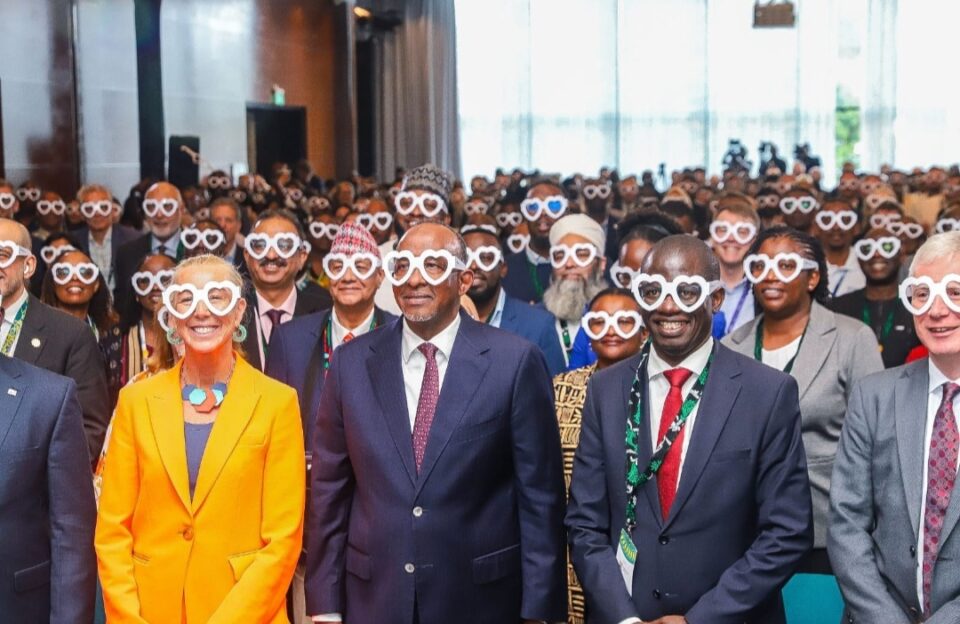
On Friday, as the 2030 Insight Live Conference on eye health entered it’s second day, local and global health leaders agreed to protect the gains already made in ending avoidable blindness.
Speakers drummed up support for what is likely to be a Nairobi Declaration when the curtains for the three-day meeting fall on Saturday afternoon.
On Thursday, when eye health stakeholders gathered in Nairobi for the first day of the meeting, there were calls for a solid commitment towards prevention of avoidable blindness. This will include raising awareness on eye health, increasing investments in terms of funding and health workforce in the sector and streamlining health systems, infrastructures and re-stocking pharmacies.
As the conference comes to a close later today, delegates including government officials acknowledged that a lot needs to be done to address the existing gaps.
Bloomberg Philanthropies founder Mike Bloomberg said untreated vision loss remains widespread despite the availability of low-cost interventions.
“When someone puts on a pair of glasses for the first time or walks out of surgery and says, ‘I can see,’ it opens up a whole new future,” he said in a recorded video statement, adding that improved vision can significantly boost education and economic productivity.
This comes as statistics show that the leading causes of avoidable blindness in Kenya, accounting for 85 percent of visual impairment, are cataract, uncorrected refractive errors, and glaucoma.
A study by The Fred Hollows Foundation and The Victoria University Institute for Economic Studies showed that every Sh130 ($1) invested in cataract surgery yields a Sh2, 600 ($20) return on investment globally and Sh6,760 ($52) in Kenya. While Kenya has increased its health sector funding significantly post-devolution from Sh8 trillion ($94 billion) in 2012/13 to Sh3.92E13 ($280 billion) in 2023/24-eye health remains underfunded and reliant on external support.
“This highlights the need for policymakers to prioritise eye health as a key driver of Kenya’s prosperity and integrate it into the broader health sector, as well as into education, social protection, and transport systems,” Ross Piper, The Fred Hollows Foundation global Chief Executive Officer said in an interview with The People Tribune at the sidelines of the ongoing meeting, describing it as a smart investment case value for accelerating prevention of avoidable blindness.
The study calls on Kenya to elevate eye health as a social, economic and development issues in the country.
Peter Holland, the International Agency for the Prevention of Blindness (IAPB) Chief Executive Officer, said the meeting comes amid rising global concern over vision impairment, which affects an estimated 2.2 billion people worldwide, with at least 1 billion cases considered preventable or treatable.
He acknowledged partners including the Bloomberg Philanthropies Vision Initiative, which has supported global efforts to expand access to basic eye care services such as screening, eyeglasses and cataract surgery.
IAPB President, Caroline Casey, president of the International Agency for the Prevention of Blindness, called for “radical collaboration” among governments, donors and health systems to address avoidable blindness.
Casey said the global movement has gained momentum through international meetings in cities including Dubai, Singapore, Mexico and Nepal, and is building toward a global summit on eye health. She described the effort as rooted in collective responsibility and drew on Kenya’s harambee spirit of unity.
She also cited findings from the IAPB “Value of Vision” report, which estimates that every Sh130 ($1) invested in eye health yields up to Sh3, 640 ($28) in economic returns. The report projects that an investment of Sh3.3 billion ($25 million) in Kenya between 2026 and 2030 could generate about Sh34.5 billion ($265 million) in economic benefits.
The forum which was officially opened by Health Cabinet Secretary, Aden Duale also had an opportunity to learn about Kenya’s health sector transformation.
The CS highlighted what the country is doing in terms of health sector reforms through its Universal Health Coverage (UHC) agenda, including expanded access to affordable eye care services.
He said more than 30 million Kenyans have enrolled in the Social Health Authority system, which now covers preventive, diagnostic, medical and surgical eye care services, including treatment for cataracts and refractive errors.
Duale said about Sh1 billion ($7.7 million) had been reimbursed to health facilities for ophthalmology services over the past 18 months, calling it evidence of growing public investment in eye health.
“Eye health is not just a health issue,” he said. “It is an education issue, a productivity issue, a development issue and an equity issue.”
He added that eye care services have been integrated into Kenya’s digital health systems to improve screening, referrals and patient tracking, and confirmed that services are now available in all 47 counties.
Despite these gains, Duale acknowledged persistent gaps in access, particularly in remote and arid regions, where health services remain limited and specialist distribution uneven.
He called for expanded recruitment, training and equitable deployment of eye health professionals, alongside stronger community-based screening and referral systems to reach underserved populations.
Health officials said Community Health Promoters will play a central role in identifying vision problems early and linking patients to care through structured referral pathways.
Experts at the conference emphasized that integrating eye health into primary healthcare systems remains critical to achieving universal health coverage and reducing preventable blindness.
Delegates also highlighted financing and workforce shortages as key barriers, calling for sustained investment and stronger coordination between governments, donors and implementing partners.
The conference runs through June 6 and is expected to produce recommendations aimed at accelerating progress toward universal access to eye health services and meeting global targets on preventable blindness.
