
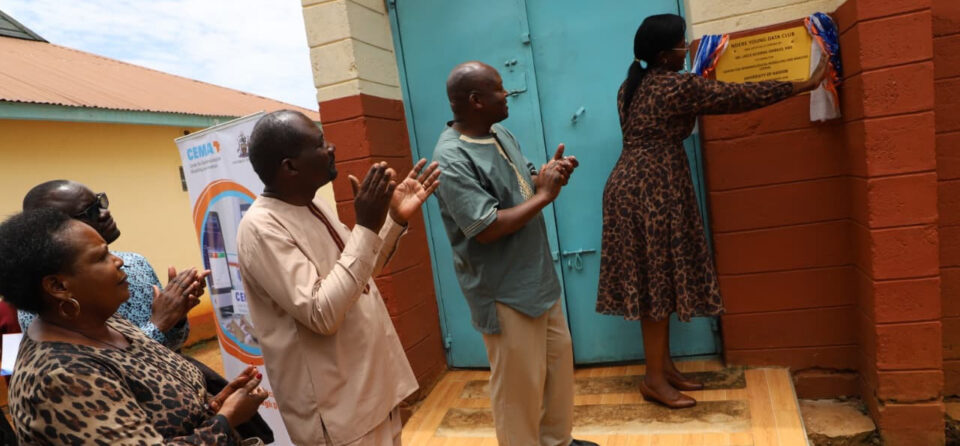
At the heart of Siaya County, lies a transformative initiative that is opening new possibilities for young learners, and it only takes someone to identify this potential. This came as a blessing for the County when the University of Nairobi knocked. On Friday last week, the Center for Epidemiological Modelling and Analysis (CEMA) within the institution, officially opened a Data Club at Ndere Mixed School in Gem Sub-County. According to the CEMA leadership, the innovative program aims to inspire curiosity, nurture ambition, and equip students with digital and data literacy skills that extend beyond the classroom. “Decisions must be based on something—and the best ones are driven by data,” said Dr. Loice Ombajo, infectious disease specialist and Co-Director at CEMA. She states that CEMA is committed to building the next generation of African experts in data analytics. “This initiative is a foundational step toward ensuring informed decision-making is embedded at the community level,” Dr. Ombajo said, noting that Africa still remains behind in data analysis and interpretation capability.
It’s an open secret that often, external actors lead data work and decision-making—leaving behind local perspectives and relevance. However, according to Dr. Ombajo, this latest initiative seeks to flip this narrative by empowering the next generation to understand and utilize data to shape their own futures.

Dr. Loice Ombajo, Infectious Disease Specialist and Co-Director, (CEMA) (far left) unveils a
plaque to signify the launch of a data hub at Ndere School as the school board chairperson,
Japheth Ochieng (2nd l), Ndere School Principal, Bernard Otieno (2nd r) and Pamela Siyumba,
Argwings Kodhek Secondary School Principal. PHOTO | UoN COMMUNICATIONS | TRBN |
Academic performance
Ndere Mixed School was chosen out of necessity: limited resources and low academic performance have held back students for decades. Located in a rural, poverty-stricken area, the school previously had only one 20-year-old computer shared among the administrative team. Students had very little exposure to computer tools, with an average school performance of a D+. “Today marks a turning point for Ndere Mixed School,” said Bernard Otieno, Principal at Ndere Mixed School. “For years, our students have worked hard despite limited resources, and for most of them, this is their very first interaction with a computer. This data club is giving them a chance to dream bigger, to see possibilities beyond the boundaries of our village.”
“We are already seeing changes–students are more motivated, performance is improving, and they are eager to come to school early just to be part of the club. They are not only learning computer skills, but also responsibility, teamwork, and confidence. This initiative has lifted the morale of both students and teachers,” Mr Otieno added.
To turn the tide, CEMA renovated a classroom, converted it to a computer lab, and donated 10 brand-new computers. The data club now has its learning space in the lab. In rural areas where poverty limits opportunity, young people often become trapped in cycles of hardship—most of them settling for low-paying casual jobs or early marriage. This initiative aims to break that cycle by equipping students with the skills and confidence to dream bigger.
“Before the Data Club launch, we faced many challenges, including limited IT personnel. Now, this initiative not only creates future job opportunities but also reduces insecurity by keeping students engaged and exposed to new possibilities,” says Collins Omondi, Parent representative. Entry is merit-based: students must show consistent academic improvement (no matter where they start from) to maintain their place in the club—adding motivation for excellence.
Teacher’s support
“As the school board, we pledge to safeguard this facility, support our teachers, and ensure this investment benefits generations of learners. We urge students to use the Data Club not only for their own growth but also for the growth of our community,” said Japheth Ochieng, Chairman of the Ndere School Board. Currently, students are being trained in basic computer literacy—writing documents, attendance tracking, and managing digital files. Students themselves proposed an early start: arriving at school by 6:45 AM, earlier than the regular classes begin, to maximize the Data Club experience. The club currently has 20–40 active members, with plans to scale to other schools in the region.
The initiative is not a “touch and go” but a long-term commitment intended to show students that a brighter future is within reach for them, equipping them with a competitive edge in today’s digital era. ‘’Students are already learning how to ask thoughtful research questions and collect data from their communities—many even spent their recent holidays doing data collection activities.”
Change your thoughts, you change your world
Climate mobile continent
A new report is showing a worrying trend of what Kenyans and other Africans should expect following the impact of climate change, warning of likely displacements and even migrations. Dubbed the State of Africa’s Environment report by the Centre for Science and Environment (CSE), India, the report reveals that by 2050, up to five per cent of Africa’s population of some two billion people could be forced to be on the move due to climate change.
“Climate change-fuelled extreme weather events are already causing unprecedented displacement across the world. In Africa, rising sea levels, prolonged droughts, cyclones, and floods are expected to intensify, threatening livelihoods, food security, and access to water,” reads part of the report.
The report warns that without urgent adaptation measures and climate-resilient development, migration will not only strain already fragile economies but also heighten conflict risks as communities compete for scarce resources. “African governments and global partners need to scale up investment in climate adaptation, strengthen early warning systems, and prioritize support for vulnerable populations most at risk of losing their homes and means of survival,” says CSE Director General Sunita Narain.
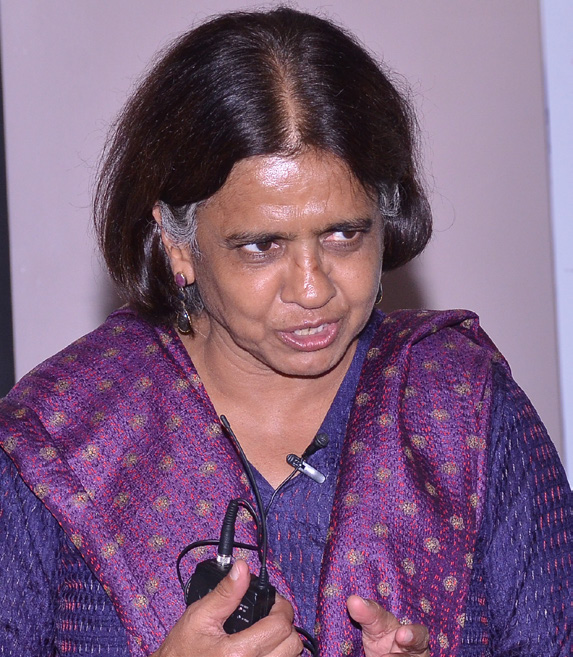
Sunita Narain, the Director-General
of the Centre for Science and
Environment (CSE). PHOTO|MINISTRY
OF ENVIRONMENT | TRBN |
According to her, irrespective of the finance crunch, countries in Africa have the responsibility and the duty to take up immediate climate change adaptation measures. According to the report, climate change is both figuratively and literally reshaping Africa. For decades, nations across the continent have struggled to move beyond colonial exploitation and violent conflicts. Just as many were finding their footing, the escalating challenge of climate change is threatening to undo hard-won progress.
An analysis by Down To Earth magazine showed that between 2021 and 2025, more than 221 million Africans were affected by weather, climate, and water-related disasters. This was more than the combined total of the previous two five-year periods. Disaster-related deaths rose to nearly 29,000, more than triple the deaths recorded between 2016 and 2020. Internal displacement in Africa has also tripled over the past 15 years. While conflict and violence remain drivers, extreme climatic events are playing an increasingly significant role. From 2009 to 2023, the number of people displaced by disasters increased six-fold.
