
A wave of anxiety and frustration is sweeping through the ranks of Kenya’s police service, as officers raise alarm over what they describe as restrictive and opaque medical cover under the Social Health Authority (SHA).
What was introduced as a universal health financing system is now, according to officers, exposing them to unexpected out-of-pocket expenses, denied treatment, and uncertainty—despite mandatory deductions from their salaries.
Many officers say they were caught off guard after discovering that the SHA- National Police Service (NPS) scheme imposes strict caps per hospital visit, with some limits going as low as Sh700 and, in many facilities, averaging Sh1,200.
“Police officers are alarmed and in a state of shock,” said one officer. “We have now learned that SHA has capped limits per hospital visit, and there are hidden restrictions that were never clearly communicated.”
The reality on the ground, officers say, is stark. In most hospitals, consultation fees alone consume nearly the entire outpatient allocation, leaving little or nothing for medication or diagnostic tests.
“Many facilities charge Sh1,000 for consultation,” another officer explained. “That leaves you with just Sh200 for drugs and any laboratory tests. What kind of treatment is that?”
As a result, officers report being asked to top up from their own pockets or return on subsequent days—an option many say is impractical given the nature of their work.
“So officers are asked to top up or come the next day,” one constable lamented. “But illness doesn’t wait, and our duties don’t allow us that flexibility.”
Last week, one officer identified as Mr Njuki who had been admitted at a Nyeri facility under the wife’s SHA cover, was detained with a bill of Sh 645, 000 with the state insurer having approved payment of only Sh 130, 00. The facility insisted on the balance of Sh 515, 000 being paid in cash maintaining that the two covers could not be used concurrently.
The situation has been compounded by reports that several hospitals previously listed as SHA-accredited have begun turning away officers seeking treatment under the scheme.
“Many officers have been turned away by facilities that were earlier circulated by SHA,” an officer noted. “You go there expecting help, only to be told they no longer accept the cover.”
Even senior officers, who traditionally accessed care in top-tier hospitals, have not been spared. Facilities such as MP Shah Hospital, The Karen Hospital, Guru Nanak Ramgarhia Sikh Hospital, and Aga Khan University Hospital Nairobi are reportedly declining to honor the SHA cover.
“These are hospitals that have always handled senior officers’ medical cases,” said a senior officer. “Now they are refusing to accept the cover. Where does that leave us?”
At the heart of the discontent is what officers describe as a lack of transparency. Beyond outpatient caps, they claim the scheme has introduced additional limits—including an annual cap of Sh100,000 for junior officers and undisclosed daily limits—without clear communication.
“This is double jeopardy,” an officer said. “You have limits per visit, limits per day, and an overall cap, yet none of this was properly disclosed.”
The frustration is further fueled by comparisons with the previous insurance arrangement under private administrators, which many officers say offered more comprehensive and predictable coverage.
“The MINET/MERKEL cover was offering better and superior services despite being a commercial venture,” one officer observed. “Now we are worse off under a government scheme.”
Reached for comment, Medical Service Cabinet Secretary Aden Duale dismissed the officers’ concern as “pure lies and propaganda.”
“These are enemies of progress, propagandists working with cartels in the health sector out to frustrate SHA,” was all that Duale said.
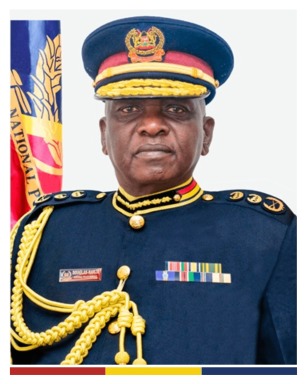
Inspector General Douglas Kanja promised to get back after we furnished him with details of some of the officers stranded in various health facilities. He did not honor his word.
The officers’ outcry comes days after the government moved to quell similar complaints from teachers who had threatened to down tools from this week. The government sealed a deal with the teachers’ unions to quell the situation.
Questions are also being raised about the financial management of the police medical cover, with officers demanding accountability for the billions allocated.
“Where did the Sh8 billion for police cover go?” one officer posed. “We are paying through statutory deductions, money is being drawn from the Treasury, yet we cannot access treatment.”
For officers and their families, the consequences are immediate and deeply personal. One officer recounted a distressing experience involving his wife at a hospital in Kakamega.
“It is very disappointing that my wife went to hospital seeking treatment under SHA, only to be told that it only covers Sh1,500, which is just enough for consultation,” he said. “After that, the doctor prescribed drugs that we had to pay for out of pocket, and in the end she was turned away without getting proper help.”
He added: “This defeats the purpose of SHA because patients expect medical support, not to be denied treatment after contributing.”
Another officer says he took his wife to Mama Lucy hospital where he had to spend Sh 4,870 from the registration to nursing services, forcing him to top up the balance.
Another grievance relates to restrictions on repeat visits, which officers say are both unrealistic and dangerous.
“We were informed that once the Sh1,500 outpatient cover is exhausted, you cannot visit the hospital again using SHA until one month has passed,” an officer said.
“This is very unfair because illness does not wait for a month.”
Such limitations, they argue, disproportionately affect officers and their dependants living with chronic conditions.
“What happens to officers or dependants with chronic illnesses who spend at least Sh15,000 per visit?” one officer asked. “How do you manage conditions like that with these caps?”
Even in facilities with slightly higher limits, officers say the math simply does not add up. One officer shared his experience at a Nairobi-based clinic.
“I was seeking treatment at a facility in Parklands for a family member and was told their cap is Sh4,000 per visit,” he said. “But Sh3,000 goes for consultation. Even a simple H. pylori test costs Sh2,200. How does one go about it?”
Healthcare providers themselves have acknowledged the constraints imposed by the revised SHA tariffs. In a notice to patients, one hospital explained that the fixed outpatient allocation—typically around Sh1,200—is intended to cover only basic services.
“This amount is meant for general consultation, essential medication, and limited laboratory tests,” the notice read. “Specialist clinics, advanced tests, and comprehensive treatment are not covered under outpatient care.”
The hospital also states that only basic laboratory investigations are included while advanced tests and procedures are not covered
The hospital further clarified that it was implementing a government directive and had no control over the policy. “We are required to adhere strictly to these guidelines,” the notice stated, adding that more comprehensive care is only available under inpatient admission, which is subject to clinical assessment.
“Due to these limitations, some conditions may not be adequately managed under outpatient care alone. It is therefore important to communicate openly with the attending healthcare provider, especially if symptoms persist or worsen, so that appropriate clinical decisions can be made,” the hospital warns.
But for many officers, admission is not always a viable or immediate option, leaving them stranded between inadequate outpatient cover and strict admission criteria.
The emotional toll of the situation is also becoming evident, with officers expressing worry, disappointment, and a sense of neglect.
“Health issues need to be addressed with urgency,” said one officer reacting to the developments. “The issues being raised are worrying. Hopefully they get addressed.”
Another added: “It is very disappointing. Patients are left stranded, especially during difficult financial times.”
As the discontent grows, broader concerns are emerging about the potential implications on national security.
“What are the implications on security when officers are struggling to access healthcare?” one officer posed. “We are expected to protect the public, yet we cannot even take care of our own health.”
For now, many officers say the silence from authorities has only deepened their frustration.
“The SHA has been mum as officers continue suffering countrywide, albeit in silence,” one officer observed.
