
By JANE WAITHIRA
The decision by Kiharu MP Ndindi Nyoro to cut ties with the ruling United Democratic Alliance (UDA) and establish his own political party has opened a new and potentially disruptive chapter in the political contest in the Mt Kenya region ahead of the 2027 General Election.
Nyoro, once regarded as one of President William Ruto’s most dependable political allies and one of the key architects of the Kenya Kwanza administration’s political and economic agenda, has now positioned himself on the opposite side of the political divide.
His launch of the People’s Party of Kenya (PPK) has not only formally ended his association with UDA but also given him an independent vehicle through which he can negotiate alliances, recruit candidates and test his influence beyond his Kiharu constituency.
The move is significant because Nyoro had, for several years, been viewed as one of the politicians who could play a central role in shaping the political direction of Mt Kenya, particularly after the fallout between Ruto and former Deputy President Rigathi Gachagua.
For months, Nyoro had kept his political cards close to his chest after announcing his detachment from UDA. He repeatedly indicated that he would reveal his political direction at an appropriate time.
That moment eventually came with the launch of PPK, marking his transformation from a senior government ally into an opposition politician determined to play a role in determining who succeeds Ruto.
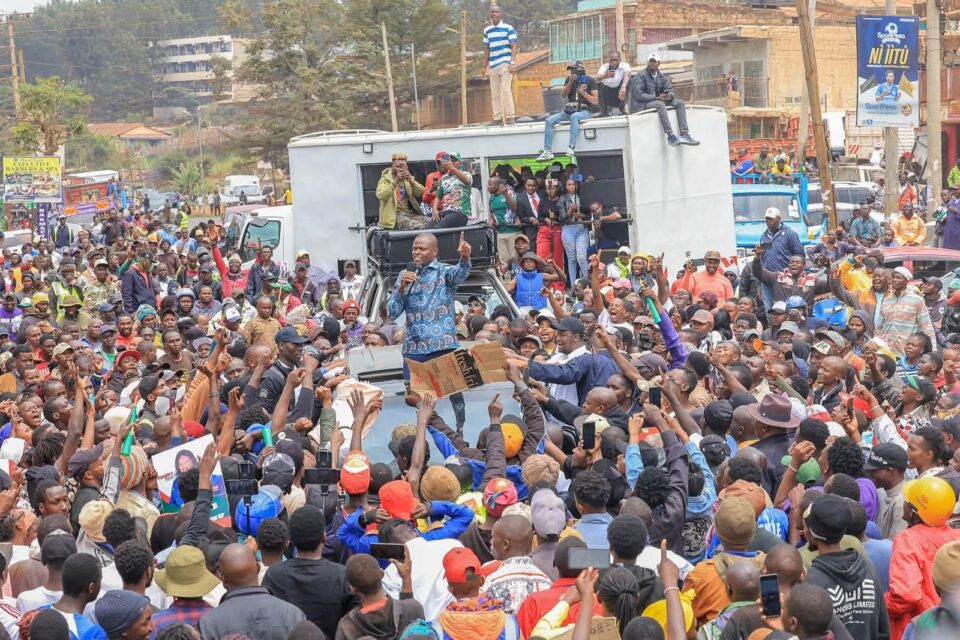
During a tour of his Kiharu constituency, Nyoro said his immediate political objective was to mobilise Kenyans opposed to the current administration and ensure that Ruto does not secure a second term in office.
He accused the President of abandoning the ordinary Kenyans who supported his rise to power, describing the development as a betrayal of the people who invested their hopes in the Kenya Kwanza administration.
“My focus right now is to work with those in opposition so that we can join hands and send Ruto home come August 2027,” he said.
The declaration puts Nyoro squarely in the emerging opposition coalition-building process, although the MP has sought to distance himself from claims that he has already entered into a formal political agreement with any particular leader.
He said he had held discussions with leaders across the opposition spectrum but had not entered into a political treaty with any of them.
His insistence on maintaining political independence could become one of the defining features of his new party as the 2027 succession contest takes shape.
Nyoro has also been forced to confront speculation that his decision could be part of a wider political strategy designed to divide the Mt Kenya vote and weaken the region’s bargaining power.
Some critics have suggested that he could be a political “mole” working to fragment the region and make it easier for competing political formations to penetrate Mt Kenya.
Nyoro has dismissed the allegations, saying his decision was the product of prolonged consultations and personal conviction.
He said he had taken considerable time before deciding to leave the ruling party and establish an independent political platform, insisting that he believes he is on the right path.
The bigger question, however, is whether Nyoro’s new political vehicle will strengthen Mt Kenya’s bargaining position or contribute to further fragmentation of the region’s political leadership.
For years, Mt Kenya has been one of the most politically influential voting blocs in the country. Its large voter population has made its support highly sought after by presidential candidates, while its ability to swing elections has given regional leaders considerable bargaining power.
The region’s political unity, however, has increasingly come under pressure following the dramatic fallout between President Ruto and Gachagua, who served as his deputy between 2022 and 2024.
Gachagua has since embarked on efforts to consolidate his political base in Mt Kenya and position himself as a key player in the 2027 presidential contest.
His political rivalry with his successor, Deputy President Kithure Kindiki, has added another layer to the contest for influence in the region.
Kindiki has emerged as one of the senior political figures defending the Kenya Kwanza administration and is expected to remain an important player in the government’s efforts to retain support in Mt Kenya.
Nyoro’s entry into this already crowded field therefore creates a third important pole of influence.
The MP was previously seen as a potential spokesman for Mt Kenya, particularly because of his close relationship with Ruto and his visibility in national political debates.
His decision to abandon UDA could now test whether he has sufficient political capital to operate independently of both the government and established opposition formations.
It will also test whether his personal popularity in Kiharu can be translated into a wider regional following.
The launch of PPK has already generated interest beyond Nyoro’s political backyard, with several leaders reportedly expressing interest in using the party as a vehicle to contest various elective positions.
That early interest could provide Nyoro with an opportunity to build a national network rather than operate solely as a Mt Kenya-based political leader.
However, establishing a political party is one thing; turning it into a serious national political organisation is another.
The party will need to attract candidates, build structures across counties, mobilise resources and convince voters that it represents more than the political ambitions of its founder.
Nyoro appears aware of this challenge.
He has said PPK is open to politicians from across the country but warned prospective members against using abusive language against opposition leaders or creating disorder during public rallies and church gatherings.
“If you know you have been insulting the opposition leaders, there is no room for you in my party. You first go reconcile with them because we cannot accommodate people who behave in such a manner,” he said.
The statement could also be interpreted as an attempt to present PPK as a disciplined political organisation at a time when opposition politics is increasingly characterised by competing personalities and shifting alliances.
Nyoro has further promised to travel across the country to areas where he campaigned for UDA and sell a different political message.
He intends to use his experience as a former Kenya Kwanza campaigner to challenge the very political narrative he once helped popularise.
This strategy could prove politically significant.
Having been part of the campaign machinery that sold the Kenya Kwanza agenda to voters in 2022, Nyoro understands the coalition’s messaging, organisational structures and voter mobilisation strategies.
His decision to campaign against the administration therefore gives the opposition a politician with first-hand knowledge of the political terrain he is now seeking to dismantle.
It also exposes him to accusations of political opportunism from his former allies, particularly those who may question why he is opposing an administration he helped bring to power.
At the same time, Nyoro’s supporters argue that his departure demonstrates political independence rather than opportunism.
In Kiharu, some residents have welcomed the establishment of his own party, arguing that it gives the MP greater bargaining power at the national level.
They point to his two terms as area MP and credit him with helping attract development projects to the constituency.
“At first we were worried that he was losing direction, but having his own party makes him a stronger political asset,” said Peter Kamau, a resident.
“We want him to go to the national level and fight for the interest of the common person who is suffering due to poor governance,” he added.
The support from his backyard will be important, but the real test will come outside Kiharu.
For PPK to become a serious player, Nyoro will have to demonstrate that his political appeal extends beyond his constituency and even beyond Mt Kenya.
The party’s performance in the recruitment of candidates and its ability to secure elected positions in 2027 will provide an early measure of its strength.
Nyoro’s political ambitions have also attracted support from senior opposition figures.
Siaya Governor James Orengo described him as one of the country’s brightest political minds, saying his decision to enter the opposition could strengthen efforts to challenge the current administration.
Orengo said Nyoro had identified problems within the country’s leadership and could contribute to finding solutions.
“We are ready to work together with him to accomplish our mission of sending home the President come next year,” Orengo said.
For the opposition, Nyoro’s defection could therefore provide an important opening into a region that has traditionally been difficult to penetrate without the support of influential local politicians.
But for Nyoro, the risks are equally significant.
If he succeeds in building PPK into a national political force, he could emerge from the 2027 election as an important power broker, capable of negotiating from a position of strength with whichever coalition wins or comes close to forming the next government.
If he fails to move beyond his constituency, however, the party could end up being viewed as another personality-driven political vehicle with limited national influence.
His decision will also test the durability of political loyalties in Kenya, where alliances often shift rapidly as elections approach.
The 2027 contest is already shaping up as a battle not only between parties but also between individual political networks, regional interests and competing succession strategies.
Nyoro’s departure from UDA adds another variable to that equation.
Having once helped build the political machinery that propelled Ruto to State House, he is now promising to dismantle it from the other side.
Whether he can persuade the voters who once trusted the Kenya Kwanza message to embrace his new political agenda could determine whether his latest move becomes a footnote in Kenya’s long history of party hopping or the beginning of a much larger political journey.
As the 2027 election approaches, the contest for Mt Kenya will increasingly revolve around who can unite the region, negotiate effectively with other blocs and convince voters that their political vehicle offers the strongest path to influence.
Nyoro’s PPK has now entered that contest.
Its biggest test will be whether it can convert the political attention surrounding its founder into a durable national organisation—and whether Nyoro can transform his break with Ruto into a credible alternative political force.
