
By TONY MUSISI
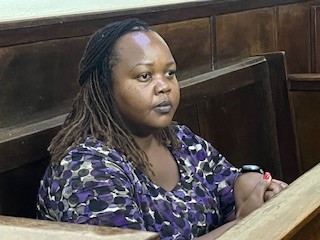
Chepkoech Too, a businesswoman and cereal farmer born out of wedlock to former Kanu nominated MP Mark Kiptarbei arap Too, has finally secured her share of the late politician’s multi-billion-shilling estate after a decade-long legal battle.
Chepkoech is one of the late politician’s three children born outside his marriages.
Following Mark Too’s death at a private hospital in Eldoret on December 31, 2016, his widows, Mary and Sophie Too, who are the joint administrators of his estate estimated to be worth more than Sh7 billion, excluded Chepkoech from the list of beneficiaries, describing her as a stranger to the family.
Determined to prove her claim, Chepkoech moved to the High Court in Eldoret, arguing that she was entitled to inherit her late father’s estate as one of his biological children.
She subsequently filed an application seeking DNA testing before then Eldoret High Court Judge Robert Wananda after being locked out of the succession proceedings.
“The only way to resolve the long-standing issue of my paternity is to order a DNA test to enable me to get a share of my late father’s estate,” Chepkoech told the court.
The court agreed with her application and directed that DNA tests be conducted by the Kenya Medical Research Institute (KEMRI).
In a ruling delivered four months ago before his transfer to Nairobi, Justice Wananda declared that Chepkoech Too was indeed a biological daughter of the late politician.
“A declaration is hereby made that Chepkoech Too is a biological daughter of the deceased based on the DNA results obtained from samples taken from her body against that of Arafat Bakari Too, a known child of the deceased,” ruled Justice Wananda.
The ruling paved the way for Chepkoech to enjoy full inheritance rights over her father’s vast estate.
DNA analysis conducted by KEMRI in Kisumu confirmed that Chepkoech and Arafat Bakari Too, although born to different mothers, are half-siblings sharing the same biological father.
The succession dispute finally came to an end on Tuesday when Justice John Chigiti, sitting at the Eldoret High Court, concluded the 10-year legal battle in less than three hours after the parties reached an agreement on how the estate would be shared.
The agreement brought to an end the long-running dispute between Chepkoech, who was the principal objector in the succession cause, and the two widows over the control and distribution of the estate spread across Rift Valley and Nairobi counties.
Under a consent signed by the parties and adopted as an order of the court, the widows agreed to formally recognize Chepkoech as a beneficiary of the estate of the late Mark Too, who also served as Assistant Minister in the Office of the President and was a close ally of former President Daniel arap Moi.
According to the consent, Chepkoech will receive 200 acres of prime agricultural land from the family’s vast land holdings in Uasin Gishu County.
She will also receive Sh15 million from the estate within 90 days in lieu of a house in Eldoret’s Elgon View Estate that she had sought during the succession proceedings.
The house was said to be occupied, prompting the administrators of the estate to compensate her with cash instead.
The consent further provides that all costs relating to the succession proceedings, including the transfer of the properties awarded to Chepkoech, will be met by the estate.
Mark Too left behind a vast investment portfolio comprising interests in several companies, including Fanikiwa Limited, East Africa Investment Trust, Charterhouse Investment Limited, Kingsway Holding Limited, Jamala Holding Limited, Great East Africa Limited and Bins (Nairobi) Limited.
His estate also includes high-value residential properties in Nairobi’s affluent suburbs of Muthaiga and Lavington, a home in Milimani, Nakuru, and another in Elgon View, Eldoret.
In addition, he left behind substantial bank deposits, a fleet of motor vehicles and 19 parcels of agricultural land spread across Trans Nzoia, Nakuru, Uasin Gishu and Nandi counties.
The consent effectively ends one of the region’s most closely watched succession disputes, paving the way for the distribution of the late politician’s estate nearly 10 years after his death.
