
By Milliam Murigi @millymur1
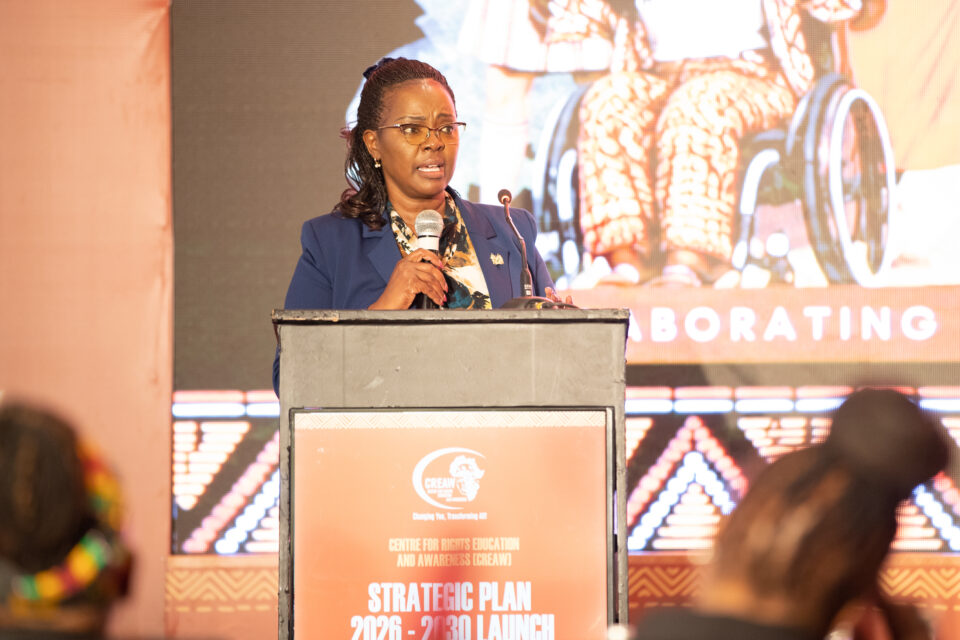
The Centre for Rights Education and Awareness (CREAW) has unveiled a new five-year (2026–2030) strategic plan aimed at addressing the growing cases of femicide and gender-based violence (GBV) in Kenya.
The strategy focuses on behavior change, community engagement, and strengthening accountability systems as key pillars in preventing violence and supporting survivors.
Speaking during the launch, Angelina Cikanda, Partnerships Lead at CREAW, said the organization is shifting focus from awareness campaigns to changing the deeply rooted cultural norms that continue to fuel violence against women and girls.
“Today marks a very important milestone where we are launching a strategic plan for 2026 to 2030 declaring our commitments to serve women and girls in Kenya,” said Cikanda.
Kenya has continued to record rising cases of femicide and GBV despite the existence of laws and policies meant to protect women and girls. According to Cikanda, the problem is not the absence of legislation, but the persistence of harmful societal beliefs and behaviors that normalize violence.
According to her, laws and policies are important because they guide how the country acts and addresses some of these challenges. However, the challenge has been that even when laws are in place, deeply rooted cultural norms continue to negatively affect women and reinforce the continued perpetration of violence.
“Many cases of violence are often normalized within families and communities, making it difficult for survivors to seek justice or support. In some communities, women and girls still face discrimination, harmful traditional practices and social expectations that silence them whenever violence occurs,” she said.
The new strategy, she explained, embeds behavior change interventions across all strategic pillars, targeting both men and women within communities. CREAW plans to use gender-transformative approaches and tested social behavior change models to promote non-violent conflict resolution and healthier relationships at household and community levels.
The organization will work closely with communities to encourage conversations around masculinity, parenting, relationships, and conflict resolution. She said promoting respectful communication and positive social values is critical in reducing violence and creating safer homes and communities.
“We are asking ourselves what is making us so violent to each other and how we can adopt non-violent ways of communicating displeasure without hurting those around us,” she said.
The organization will also work closely with partners and communities to implement methodologies designed to transform attitudes, improve interpersonal relations and create safer environments for women and children.
Part of the strategy will also focus on strengthening grassroots engagement by working with community leaders, youth groups, women-led organizations, religious institutions, and schools to challenge harmful stereotypes and promote equality.
The organization further plans to enhance advocacy efforts aimed at strengthening institutional accountability and improving access to justice for survivors of violence, particularly in marginalized and underserved communities.
She also challenged the government to strengthen enforcement of existing laws and ensure survivors of violence experience real justice.
“Government has a bigger role to play because it is responsible for all of us as mandated in the Constitution,” she said. “When matters are presented in court, they should be treated with the urgency they deserve, and every actor from police to judiciary to community leaders must be held accountable.”
Cikanda further called for rehabilitation programs for perpetrators of violence to help them adopt healthier ways of relating within society. She emphasized that addressing GBV requires a whole-of-society approach that includes prevention, accountability, and long-term social transformation.
Speaking during the event, Anne Wang’ombe, Principal Secretary in the State Department for Gender and Affirmative Action, emphasized that eradicating gender-based violence and safeguarding the rights of women and girls requires robust, collective action across all sectors.
She urged citizens to speak out against violence, support women’s ambitions, actively champion equality, and reject the normalization of violence within communities.
“Ending GBV is not the responsibility of one institution alone. It requires all of us, including government, civil society, religious leaders, families, and citizens, to work together to protect women and girls,” she said.
Additionally, she said that the department will implement all actionable recommendations contained in the GBV-Femicide Taskforce report and push for legal and policy reforms that safeguard the rights of women and girls without compromise.
The strategic plan comes at a time when civil society organizations and activists are increasingly calling for urgent action to curb the rising wave of femicide and violence against women in Kenya. Recent protests and advocacy campaigns across the country have highlighted growing public concern over the increasing number of women killed or subjected to violence.
