
When his wife goes into labour, Moses Onkwani no longer takes chances.
The husband, and caregiver from Esise Ward in Borabu Sub-County says the disruption of public health services has forced him to look beyond the facilities he once relied on, sometimes selling chickens to raise money for private maternity care.
“I am forced to sell chicken and other items such as bananas and vegetables so that I save money. When my wife is due, I just take her to a private hospital where she can get it,” Onkwani told The People Tribune in an interview.
But for many women in his village, even private care is beyond reach.
Onkwani says women who previously travelled to health facilities to deliver with the help of skilled birth attendants are increasingly resorting to home deliveries as the nurses’ strike continues.
He fears the situation could deteriorate further if the disruption persists.
His experience offers a glimpse into how a dispute over the terms and conditions of health workers is being felt far beyond negotiation rooms—in homes where families must now find alternative ways of accessing services they previously expected to receive in public hospitals.
At Kijauri Sub-County Hospital, the impact is already visible inside the facility.
A clinical officer at the hospital says the nurses’ industrial action has seriously disrupted antenatal care, immunisation and maternity services, leaving the remaining health workers to stretch beyond their normal duties to keep essential services going.
At times, she says, she has had to assist expectant mothers in maternity despite maternity nursing not being her area of specialisation.
“If a pregnant is presented at the maternity, I have no option but to pull on the gloves and assist in delivering the baby as much as this service is not within my terms of reference as a clinician,” the clinical officer said on condition of anonymity as she is not authorized to talk to the media.
The clinical officer also describes shortages of equipment and essential consumables, including gloves, cotton wool and other supplies, adding another layer of difficulty for health workers trying to maintain services.
Immunisation has also been affected.
She says routine maternal and child health services have been disrupted, with maternity and Maternal and Child Health (MCH) services affected by the shortage of nurses.
What is happening at Kijauri, however, is unfolding against a deeper workforce problem.
Evidence from the Health Facility Census by the Ministry of Health shows that only 12 counties met the core staffing requirement, while the World Health Organization’s (WHO) latest workforce assessment puts Kenya’s health workforce at just 76.4 per cent of estimated need.
The numbers point to a health system that was already operating with significant gaps before the current labour dispute.
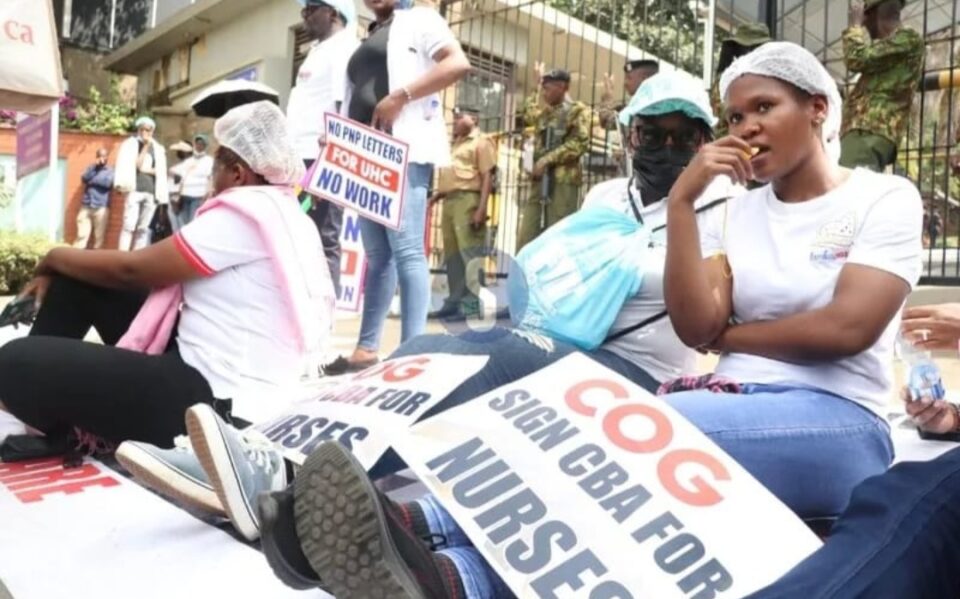
The nurses’ strike has therefore exposed more than an industrial disagreement. It has exposed how heavily Kenya’s promise of Universal Health Coverage (UHC) depends on a workforce that is itself under pressure.
The Kenya Progressive Nurses Association (KPNA) has warned that every additional day of industrial action risks deepening disruption to essential primary healthcare services.
According to the association, more than 3,000 infants could be missing routine immunisation services each day, while more than 10,000 pregnant women may be missing antenatal care appointments.
The association also estimates that more than 2,500 facility-based deliveries are being displaced daily, while about 15,000 family-planning clients are losing routine access to reproductive health services.
This is reinforced by the observations at the Kijauri health facility and in Onkwani’s community, demonstrating the type of disruption the association is warning about.
“Nurses and midwives form the backbone of primary healthcare,” Triza Ireri, KPNA National Secretary says, arguing that unresolved labour agreements, career progression and employment conditions threaten the country’s Universal Health Coverage ambitions.
Among its demands are the conclusion of the pending 2025–2029 Collective Bargaining Agreement (CBA), implementation of commitments contained in previous return-to-work agreements, transition of contract-based UHC workers to permanent and pensionable terms, and implementation of approved career progression guidelines across the 47 counties.
As the crisis continues to deepen, Aska Moraa, a nurse in a county hospital in Nyamira explains that as a result children are missing almost all those vaccinations.
“I can say all of them,” she said starkly when asked which routine doses the children could be missing.
Moraa attributed this to the lack of staff adequately oriented to provide immunisation services.
“We don’t have enough gloves. We don’t have enough consumables, like cotton wool,” a member of KPNA, she noted on the health products and commodities.
“There are no services of MCH at all given. MCH is closed.”
The Council of Governors, however, disputes the picture of a nationwide shutdown.
Speaking about the labour unrest, the Council says only nurses and members of the Kenya Union of Clinical Officers (KUCO) are currently on strike and maintains that the action is limited to some counties rather than the entire country.
“In fact health-sector labour unrest has declined significantly compared with previous years,” CoG Chief Executive Officer, Mary Mwiti said during a media forum in Mairobi. She argued that 14 years of devolution have produced stronger structures and systems for resolving disputes between counties and health-worker unions.
On nurses, the Council says it has engaged governors on measures to prevent the strike from continuing and is awaiting a memorandum from the nurses.
Mwiti says the 47 county governments are ready to engage and negotiate with nurses to restore full service delivery, expressing confidence that the outstanding issues could be resolved.
But the competing positions reveal a deeper problem.
For county governments, the dispute is about agreements, implementation, remuneration and the machinery of devolution, while for the nurses, it is about whether they have the conditions, staffing levels, career structures and employment security required to deliver care.
However, on the patient’s position, the question is simpler: whether the service they were promised will be available when they need it.
And various arguments indicate that this is where Kenya’s UHC promise now faces its most uncomfortable test.
The health worker is asking: Give me the conditions to deliver.
The patient is asking: Give me the service you promised.
And the state is left facing a difficult question: How did both sides of that UHC contract become so vulnerable at the same time?
At Kijauri, the answer is visible in a clinical officer stepping into maternity care outside her normal area of specialisation.
In Esise Ward it is visible in a caregiver selling chickens to pay for private maternity services.
And in the workforce figures, it is visible in a system that was already operating below its estimated staffing needs.
The current industrial action may eventually be resolved at the negotiating table.
But the deeper workforce problem will remain.
For Kenya’s UHC ambitions, that may be the more consequential conversation.
For Onkwani, however, the issue is immediate.
When his wife goes into labour, he wants to know there will be a safe and affordable place for her to deliver.
“I am really asking and pleading with the government to sort out this issue before things go out of hand,” he says.
