
By WYCLIFFE MUIA, BBC
During the rainy season, swarms rise from thousands of anthills across Gilgil, a quiet agricultural town in the Rift Valley that has become the centre of a booming illegal trade.
This spectacle marks the ants’ mating ritual. Winged males leave their nests to fertilise queens, which also take flight. But this natural process has created an opportunity for smugglers targeting one of the most valuable insects on the global black market—the giant African harvester ant queen.
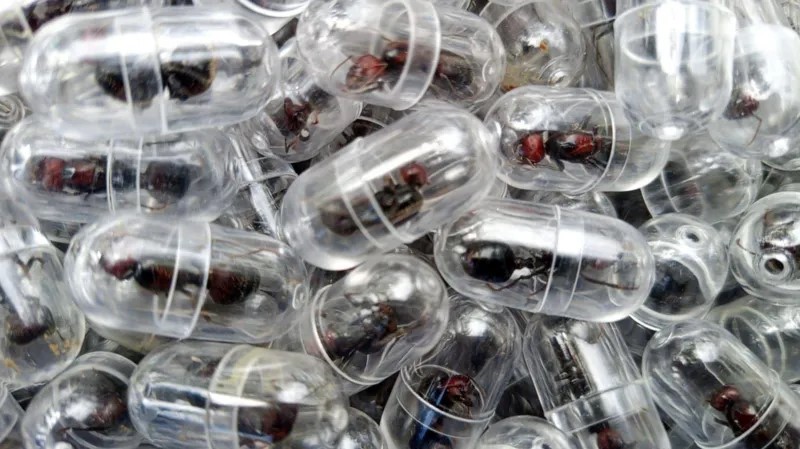
These large, reddish ants, scientifically known as Messor cephalotes, are highly prized by collectors who keep them in transparent enclosures to observe colony-building behaviour. A single fertilised queen can produce an entire colony and live for decades. On the black market, one queen can fetch up to £170 ($220), with most sales taking place online.
Their small size makes them easy to smuggle. Scanners rarely detect organic material, allowing traffickers to transport them discreetly.
“At first, I did not even know it was illegal,” said a former broker who requested anonymity, recalling how he once linked foreign buyers with local collectors.
“A friend told me a foreigner was paying good money for queen ants—the big red ones commonly seen here,” he said. “We would search for anthills early in the morning. The foreigners never came to the fields. They stayed in town while we delivered the ants to them packed in tubes or syringes they provided.”
The scale of the trade shocked authorities last year when 5,000 live queen ants—mostly collected around Gilgil—were discovered in a guest house in Naivasha. The suspects, from Belgium, Vietnam, and Kenya, had packed the ants in test tubes lined with moist cotton wool, allowing them to survive for up to two months, according to the Kenya Wildlife Service (KWS).
The ants were destined for markets in Europe and Asia.
The discovery surprised scientists and authorities alike. Kenya is more accustomed to high-profile wildlife crimes involving elephant ivory and rhino horns, not insects.
“Even I, as an entomologist, have been surprised at the extent of the trade,” said biologist Dino Martins, noting that Kenya is home to around 600 ant species.
Despite this, Martins understands the fascination with harvester ants. A single queen can grow up to 25mm long and produce eggs throughout her life. Colonies can grow to hundreds of thousands of ants and survive for decades.
“They are fascinating species. They form large colonies, display complex behaviours, and are relatively easy to keep,” he said.
During mating, queens mate with several males, which die shortly afterward. The queen then burrows into the ground to begin laying eggs and building a colony. Worker and soldier ants—all female—eventually emerge to sustain and defend the nest.
Colonies can survive for 50 to 70 years, and the queen lives just as long. Once she dies, the colony collapses.
This ecological role makes the illegal harvesting of queens particularly dangerous. Removing them destroys entire colonies, disrupting ecosystems.
Many Kenyans know how resilient ant colonies are, especially when they invade homes or farms. Eliminating them often requires locating and killing the queen, usually hidden deep underground.
The former broker admitted that collectors sometimes disturb anthills to force queens out.
“It was only after I saw arrests on the news that I realised what I had been part of,” he said. “I quit immediately.”
Those arrested in the Naivasha case were convicted of biopiracy and fined $7,700 or given a 12-month jail option. They chose to pay the fine and left the country.
However, the trade continues.
Recently, a Chinese national believed to be linked to the earlier operation was arrested at Jomo Kenyatta International Airport with another 2,000 queen ants packed in test tubes and tissue rolls.
Scientists warn that such trafficking could have serious environmental consequences.
Researcher Zhengyang Wang cautioned that the trade could “wreak havoc” on ecosystems if left unchecked.
Mukonyi Watai, a senior scientist at the Wildlife Research and Training Institute, agrees.
“Unsustainable harvesting—especially of queen ants—can lead to colony collapse, disrupting ecosystems and threatening biodiversity,” he said.
While it is possible to collect ants legally in Kenya, the process is strictly regulated. Collectors must obtain permits and sign benefit-sharing agreements with local communities. These agreements also require records of the number of ants collected and their destination.
According to KWS, no such permits have been issued so far.
Some conservationists are now calling for stronger global protections. Currently, no ant species is listed under the Convention on International Trade in Endangered Species (CITES), leaving the trade largely unregulated.
“Without international monitoring, the scale of this trade remains invisible,” said Sérgio Henriques, a researcher studying the global ant trade.
For Kenyan authorities, the immediate challenge is enforcement. KWS has described insect trafficking as under-reported and difficult to track. The agency is calling for improved surveillance at airports and border points.
Martins believes current detections represent only a small fraction of the actual trade.
“It is likely we are seeing just a fraction of what is really happening,” he said.
Yet not everyone sees the trade as entirely negative.
Journalist Charles Onyango-Obbo argues that Kenya may be missing a major economic opportunity.
“Ants are not finite resources like gold or diamonds,” he wrote. “They are biological assets that can be bred and farmed at scale.”
In fact, Kenya’s cabinet recently approved policy guidelines aimed at commercialising the wildlife economy, including insects such as ants.
“The goal is to promote sustainable trade in species like ants to generate jobs and support livelihoods,” Watai said.
If properly regulated, the trade could benefit rural communities. Farmers in areas like Gilgil could supplement their income by rearing ants alongside traditional crops.
However, the debate remains unresolved.
While some see economic potential, others warn of ecological risks and the consequences of exporting species across ecosystems.
For now, the flying ants of Gilgil remain both a natural wonder and a symbol of a growing underground trade—raising urgent questions about conservation, regulation, and opportunity in Kenya.
