
By GASTONE VALUSI
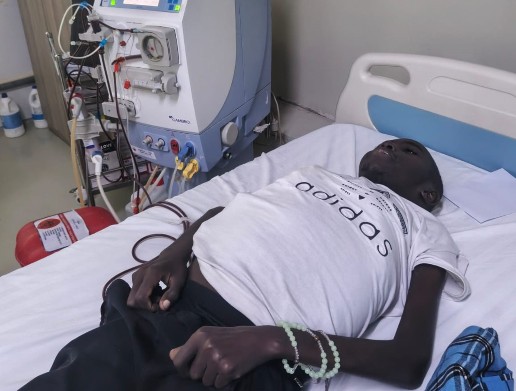
He speaks in halting, monosyllabic bursts—like a child learning to talk. His reluctant, staccato speech, punctuated by deep breaths and sighs, betrays a man in pain, struggling to remain brave in the face of a debilitating illness.
At just 30, Eric Munyao is fighting for his life.
Since graduating with a Bachelor’s degree in Political Science with IT from Maseno University in 2022, Munyao has been battling chronic kidney disease. This condition has drained him physically, emotionally, and financially.
Back home in Kako, Mbooni Sub-county in Makueni County, his peasant parents had sacrificed everything to educate him, hoping for a brighter future. Today, that hope hangs by a thread. The family has sold nearly all they owned—livestock, land, and even their small shop—to fund his treatment.
But it is still not enough.
Munyao says he has explored every possible avenue to raise funds, including reaching out to Makueni Governor Mutula Kilonzo Jnr. He claims that although he once received an appointment, the meeting never materialised.
“We have tried everything. We went to the governor’s office on his invitation, but he did not turn up. That was last month,” Munyao says during a strained phone interview with People Tribune, struggling to narrate his ordeal.
He has sought treatment in several hospitals, including Nairobi West Hospital and facilities in Kitengela, where he currently undergoes dialysis. The procedure costs him about Sh35,000 per week—an amount that is both financially and emotionally draining.
Doctors have now recommended a kidney transplant, which will cost approximately Sh4 million—far beyond what his family can afford.
Munyao’s story mirrors the silent suffering of hundreds of Kenyans grappling with chronic kidney disease.
Growing up in rural Makueni, he was a bright and ambitious boy with big dreams. But shortly after graduating in 2022, he was diagnosed with the disease and admitted to Makueni County Referral Hospital for two months.
Today, he lives in Kitengela with his wife, Caroline, who has become his full-time caregiver.
In his own words, Munyao recounts his journey:
“My name is Erick Mutua Munyao. I am 30 years old.
I attended Komarock Primary School, then Wambiti Primary, before joining Kyang’ondu Secondary School. I later joined Maseno University for a degree in Political Science with IT.
For the past three years, I have been on dialysis because I cannot pass urine. During my sessions in Wote, I lost my eyesight in both eyes. I later moved to Kitengela, where I underwent successful surgery at City Eye Hospital to restore my vision.
I currently undergo dialysis at Kitengela West Hospital. Due to my condition and the long-term effects of dialysis—including vision problems, blood pressure fluctuations, body weakness, weight loss, and persistent pain—I was advised to undergo a kidney transplant.
Last year in February, I consulted hospitals locally and in India. I chose MP Shah Hospital due to its success rate. The total cost of pre-transplant tests, the surgery, and post-transplant care is about Sh4 million.
We have tried everything to raise the money, including harambees and contributions from friends, but we have not even raised a quarter of the amount. We have exhausted all options.”
His father, Geoffrey, says the family is now completely drained.
“My son has been very sick for years. I have sold almost everything I own—land, livestock, even a plot—but I still cannot raise the required amount,” he says.
“I have nothing left to sell. I am appealing to well-wishers to help save my son. He needs about Sh4 million for a kidney transplant in India.”
Now, Munyao is making a desperate appeal:
“I ask all people of goodwill to help save my life.”
Those willing to assist can send contributions via Paybill: 5451032
Account Name: Erick
Phone: 0727 972620 / 0705 587688
A Growing National Concern
Munyao’s plight raises troubling questions about the rising burden of chronic illnesses in Kenya.
What is driving the increasing cases of kidney disease, even among young people? Is dialysis truly sustainable, given its high cost? And who ultimately bears the burden—the patient or the system?
Statistics paint a worrying picture:
• 1 in 10 Kenyans suffers from chronic kidney disease (WHO, 2020)
• About 3,000 Kenyans undergo dialysis annually (Kenya Renal Registry, 2022)
• Kenya spent an estimated Sh10 billion on dialysis and transplants between 2020 and 2022
Dr Thomas Ouma, a consultant paediatric nephrologist, warns that kidney disease is becoming a major public health concern.
He attributes the rise to unhealthy lifestyles, untreated hypertension and diabetes, low public awareness, and environmental factors.
“Chronic kidney disease is a major burden. One to two out of every 10 people may be affected. We must take preventive measures seriously,” he says.
Dr Ouma notes that poor diets, inadequate hydration, sedentary lifestyles, and pollution are key contributors. He adds that many patients only realise the importance of kidney health when it is too late.
The cost of treatment, he says, is beyond the reach of many families.
“Managing kidney failure through dialysis or transplant is extremely expensive. Many families simply cannot cope,” he explains.
He emphasises that most kidney diseases are preventable through simple measures such as proper hydration, balanced diets, regular check-ups, and monitoring blood pressure and sugar levels.
Dr Ouma is also calling for expanded screening services, noting that basic urine and blood tests can detect early signs of kidney disease.
“Early detection is the best way to prevent complications,” he says.
He further urges the government to include kidney treatment under national health insurance to ease the financial burden on patients.
Munyao’s neighbour, Peter Kamau, is urging both national and county governments to invest in modern medical equipment to reduce reliance on expensive treatment abroad.
He notes that Kenyans spend billions annually seeking advanced care in countries such as India and those in Europe—money that could instead be used to upgrade local healthcare systems.
“Our country has qualified specialists. What we lack is advanced equipment,” Kamau says.
“Investing in modern facilities will save lives and reduce the financial burden on families.”
