
To millions of Kenyans, March 3, 2026 was no more than just an ordinary work day.
On the contrary, the Africa Environment Day, also known locally as the Wangari Maathai Day, to honor the Nobel Laureate’s legacy, was a landmark day for conservationists and young environmental activists to raise awareness on the continent’s pressing ecological challenges.
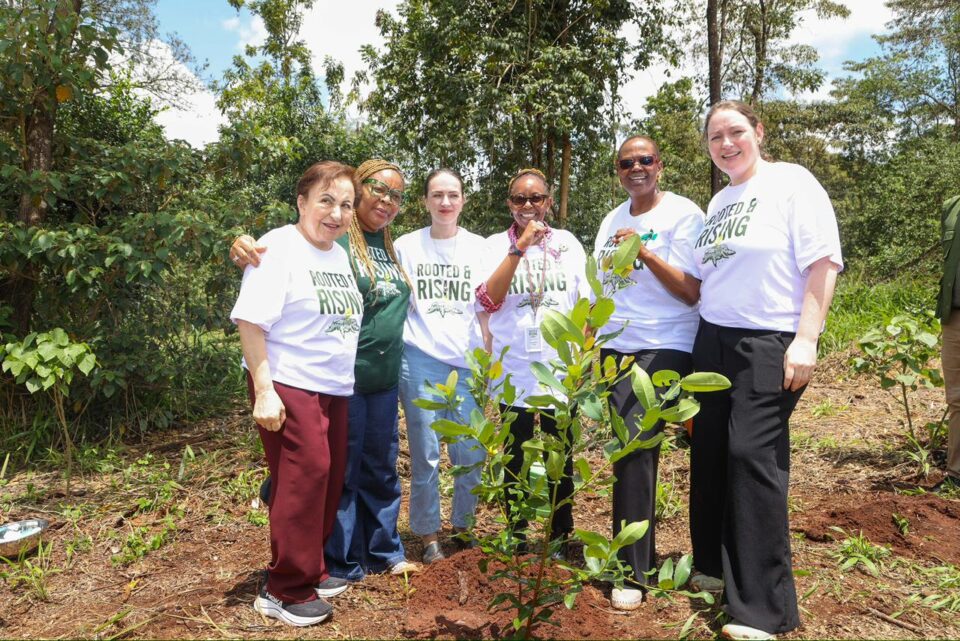
Again, unknown to millions of Kenyans, March 3, 2026 saw three Nobel peace laureates come together at the Karura Forest, Nairobi’s greenest section to keep the late Prof. Maathai’s legacy alive.
Under the invitation of Nobel Women’s Initiative, Peace Laureates Leymah Gbowee, Oleksandra Matviichuk, and Shirin Ebadi took part in a series of activities; from lectures, nature walk to tree planting. The three laureates honoured Prof. Maathai’s environmental conservation legacy.
“Caring for the earth is a form of care for humanity,” Matviichuk, a prominent Ukrainian human rights lawyer and civil society leader, echoed Prof. Maathai’s famous words.
Matviichuk praised Maathai’s “stubbornness” and resilience in preserving natural spaces, specifically highlighting the protection of Karura Forest.
While reflecting on the link between democracy and environment, she noted that environmentalists and human rights defenders often fight the same battles against corruption and abuse of power.
“The struggle for land in Kenya and the fight for freedom in Ukraine, have similarities that cannot be ignored,” she said, noting that both require defending against forces that disregard life and dignity.
As part of the Rooted and Rising initiative, a 2026 program convened by the Nobel Women’s Initiative in partnership with the Institute on Gender, Law and Transformative Peace at CUNY School of Law in New York, Matviichuk emphasized that publicity is still needed to save natural resources. She noted that international, and cross-continental solidarity, are essential.
“There’s a strong connection between environmental protection, human rights, and the fight against authoritarianism, and our sister Wangari Maathai stood firm on this,” she added.
The Africa Environment Day is celebrated annually on March 3 alongside Wangari Maathai Day. It was established by the African Union in 2002, and promotes sustainable development, tree planting, and biodiversity conservation to combat degradation.
Ebadi, a prominent Iranian human rights lawyer, author, and former judge highlighted Maathai’s refusal to give up, noting that despite the long struggle, she successfully saved the Karura Forest and returned it to the community.
“Tree planting is a legacy, and it’s important that we honor Maathai’s “seed of peace” philosophy,” she said.
Reflecting on Maathai’s dedication, Ebadi highlighted the lasting impact of the late laureate’s work, which included fighting to ensure future generations would enjoy the forest.
“It’s therefore important to have women-led climate action,” she said, highlighting the intersection of environmentalism with democracy and human rights.
Gbowee, a peace activist from Liberia emphasized the urgent need for African nations to integrate the younger generation into the green economy and conservation efforts.
Speaking in Nairobi during the same events honoring, Gbowee highlighted that while conservation is vital, there is a risk of losing momentum if youth are not properly trained and involved, particularly concerning the continent’s natural resources.
“Governments must align education curricula and national policies with the green economy, moving beyond traditional careers to focus on sustainable agriculture, conservation science, and mineral resource management,” said the Monrovia-born activist who led a nonviolent women’s movement that helped end the Second Liberian Civil War in 2003.
Alongside the other two peace laureates, Gbowee participated in planting trees at Karura Forest, describing the act as a “living symbol of resilience, courage, and the power of women to shape a more just and peaceful world.”
She emphasized that working with the younger generation is crucial in ensuring that they understand and protect what they have inherited.
The three laureates were in Kenya to celebrate the 20th anniversary of the Nobel Women’s Initiative and to champion climate justice. They advocated for continued action for environmental justice.
