
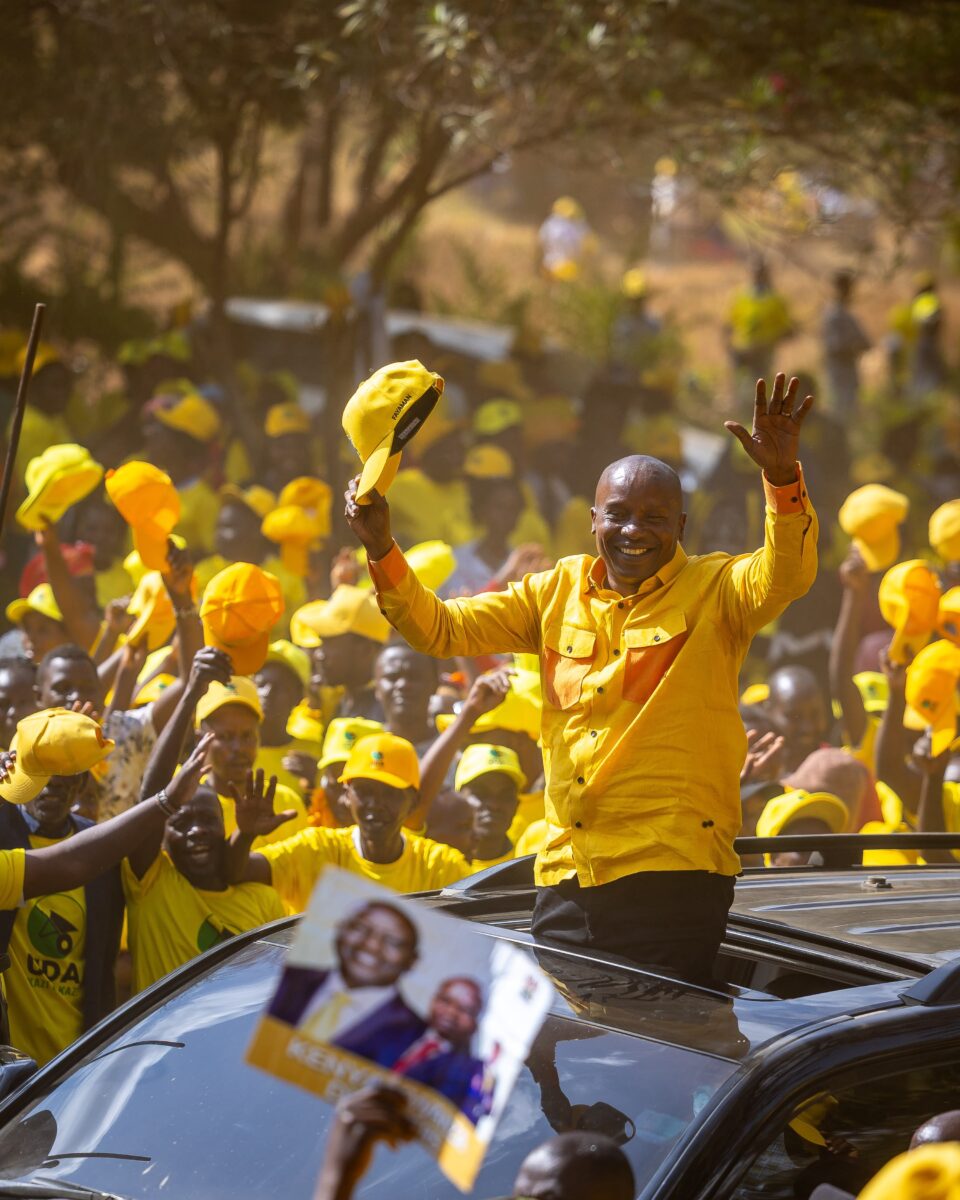
By OLIVER MUSEMBI
Deputy President Kithure Kindiki has disclosed how he attempted to save Democracy for the Citizens Party (DCP) leader Rigathi Gachagua from impeachment.
Kindiki claimed that while serving as Interior Cabinet Secretary, he advised Gachagua against fighting his boss, President William Ruto, but was ignored by the former Deputy President.
“I advised him not to undermine the President because he was serving under him, but he brushed me off. I told him if he wanted to fight his boss, he should quit his job and join the opposition or else he would be kicked out,” recalled Kindiki.
The Deputy President claimed Gachagua had at one point asked him to quit the Government during his fallout with Ruto, but he refused.
“This is our government. We cannot leave because if we leave, other people who never voted for this government would be called in and they would take over our jobs,” he recalled telling his predecessor.
Kindiki spoke on Thursday while inspecting the Sh2.5 billion Kibugua-Mukuuni-Itugururu-Kabururu-Kamaindi-Murugi Road Junction project in Chuka Igambang’ombe Constituency, Tharaka Nithi County.
The road is expected to ease movement and improve farmers’ access to markets.
He challenged Gachagua to explain to Kenyans which roads, water projects and electricity connections he helped secure while in government before attacking the current administration.
“Before he talks about ‘one term’, ‘Kasongo’ and ‘Soprano’, firstly he should tell the people of Tharaka Nithi, when he was in power, which road he constructed, which water projects he brought, and which electricity he brought,” he said.
Kindiki also maintained that he never undermined Gachagua while the latter was Deputy President, saying his two years as Interior Cabinet Secretary were largely devoted to national security.
“I never insulted the one who had sat on the seat of Deputy President. There is not even one day that I insulted him,” he said, referring to his predecessor.
He challenged Gachagua and other critics of President Ruto to put their development records on the table for comparison with those of the Kenya Kwanza administration.
“Let those who are criticising us put their development record on the table when they held positions of influence, then let Kenyans compare their scorecard with ours,” he said.
With the 2027 General Election approaching, Kindiki said the political contest would ultimately be settled on the ground.
“Let us meet on the ground. You cannot match our energy. You cannot match our skills. You cannot match our efforts,” he said.
At the same time, Kindiki hailed the proposed National Infrastructure Fund as a solution to Kenya’s road financing challenges, promising major road projects across Mt Kenya East.
He said the next major dual-carriageway project after the Rironi-Mau Summit Road would run from Makutano through Mwea, Embu, Chuka, Meru and Maua.
“After the Rironi-Mau Summit Road, the next dual carriageway we are planning for will be in this region and I can assure it will be a major economic boost to people living and doing business around Makutano, Mwea, Embu, Chuka, Meru and Maua,” Kindiki said.
The Deputy President further said the National Infrastructure Fund would mobilise substantial resources for major roads and end the practice of spreading resources over short stretches of road.
“We have to stop with things of five, six kilometres, 15 kilometres, because if we continue at that speed, this country will remain behind for a long time,” he said.
Kindiki said the Government had planned to turn Kenya into a construction site over the next 10 to 15 years and transform it into a first-world country within two to three decades.
In Maara, Kindiki inspected the Marima-Makutano Road, which he said would extend the completed Kathwana-Makutano road and link it to the Thuci-Nkubu road.
He also praised young people working on the Chuka project, saying infrastructure development was creating jobs for skilled workers and artisans.
“I am very happy to see young people actively working. When we see this kind of energy, focus, professionals and artisans, we feel very good, and we see that our country has hope,” he said.
