
By ERIC JUMA
The National Government, in partnership with the Siaya County Government, has rolled out a last-mile water connectivity programme aimed at ending perennial water shortages in Ugunja, Sega and Ukwala towns.
Siaya Bondo Water and Sanitation Company (SIBOWASCO) Managing Director Isaiah Adipo said contractors implementing the first and second phases of the programme had already commenced work.
The two-phase project, which seeks to expand water supply in Ugunja and Ugenya sub-counties, targets to connect 3,000 households to the water network.
“The National Government, through the Lake Victoria North Water Works Development Agency, will connect 1,200 crucial customers, including health centres and schools, while 1,800 customers will be connected through the Financing Locally Led Climate Change Action programme. The latter is consuming Sh37 million,” Adipo said.
He said the projects would source water from the Areca Water Scheme, one of the 10 water schemes in Siaya managed by SIBOWASCO.
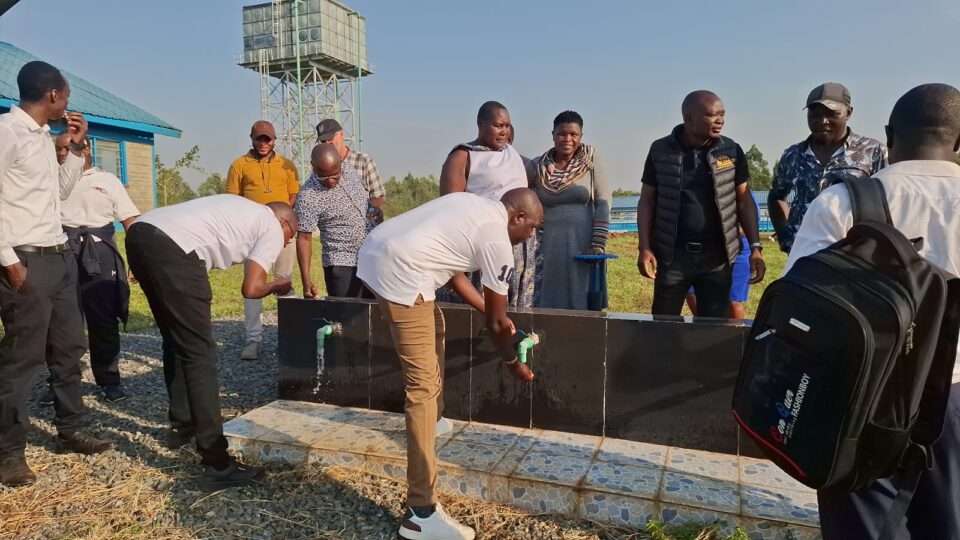
Adipo spoke during a visit to the Areca site in Ugunja Sub-County, where he hosted partners from EcoRural, Ghana Water technical teams, and managers of Ujimbe and Akala water projects to assess the multimillion-shilling project designed to increase bulk water supply.
The last-mile connectivity programme is scheduled for completion on April 14, 2027.
“Our focus is delivering value for money and improving customer satisfaction. With the implementation of the last-mile connectivity programme, the people will benefit from this commodity,” Adipo said.
He said the project was designed to improve access to safe drinking water by expanding the distribution network and addressing the longstanding challenge that has forced many households to rely on saline boreholes and irregular water supplies.
Adipo added that the Sh1 billion Ugunja-Sega-Ukwala Water Project was implemented under the Kenya Towns Water Supply and Sanitation Programme (KTSWSSP) and jointly funded by the African Development Fund (AfDB) and the Kenyan Government.
The project established bulk water infrastructure designed to produce and supply more than 8.4 million litres of treated water daily to more than 100,000 people across Ugunja, Sega and Ukwala towns.
The project’s storage facilities include steel tanks at Nyambiro with a capacity of 300 cubic metres, Yenga (300m³), St Sylvester Anyiko (500m³) and Madungu (1,000m³), as well as a reinforced concrete ground tank at Got Osimbo with a capacity of 1,500m³.
In a unique sustainability feature, the scheme incorporates three hydropower turbines to generate renewable energy, reducing electricity costs and helping ensure uninterrupted water production.
Residents of Ugunja welcomed the initiative, saying reliable access to clean water would improve living conditions and contribute to Kenya’s efforts to achieve Sustainable Development Goal Six, which seeks universal access to safe and affordable drinking water.
Resident Dick Okello said the growing population in Ugunja and Ugenya constituencies had continued to put pressure on existing water infrastructure, making expansion of the supply network critical to meeting the community’s needs.
Other residents said prolonged reliance on saline borehole water had affected both household consumption and infrastructure.
Jerry Ochieng’, a resident, expressed optimism that the project would provide a lasting solution to the water shortage but urged the relevant agencies to complete the remaining works on schedule and ensure all targeted households were connected.
Lead trainer in water utility management at the IHE Delft Institute for Water in the Netherlands, Prof Klaas Schwartz, described the water project as impressive, saying it could help address the region’s longstanding water challenges.
“I am amazed by the kind of engineering on the water project, right from the intake to the turbine unit. We are impressed by the way water pumps continue their work even during power outages,” Schwartz said.
“It has been an amazing visit and, for sure, these are very good plants. I want to document it so as to replicate projects with similar designs,” he added.
Schwartz thanked SIBOWASCO for allowing the visiting team to tour the water projects.
Mawunyo Kofiloto, a facilitator in water utility simulation, described the field visit as an eye-opener, saying it had provided participants with an opportunity to learn practical lessons in water utility management.
Africa Water Watch Managing Director William Mboya said SIBOWASCO had been an important partner in the EcoRural programme, helping water utility managers acquire knowledge and skills on running water schemes and developing sustainability strategies.
“As a key partner, SIBOWASCO has taken us to water projects and we have learnt how water is abstracted, brought for treatment and then pumped for consumer use,” Mboya said.
He commended Water Executive Prof Jacqueline Oduol and Chief Officer Judy Oyugi for embracing partnerships aimed at building the capacity of managers of community water schemes.
