
By ROBERT GITHU
Deep in the heart of Samburu County, within the lush Namunyak Conservancy, lies a sanctuary offering a second chance to some of Africa’s most vulnerable giants — orphaned elephant calves.
Founded in 2016, Reteti Elephant Sanctuary is the world’s first indigenous community-owned elephant sanctuary, where abandoned and orphaned calves are rescued, rehabilitated and eventually released back into the wild.
Supported by the Kenya Wildlife Service, Samburu County and the local Samburu community, Reteti stands as a powerful example of how locally driven conservation can protect wildlife while empowering communities.
Russia Lenanyokie, a keeper at the sanctuary, explains that calves become orphaned when their mothers die naturally, are separated from their herds, or fall into man-made wells dug in dry riverbeds as elephants search for water.
During dry seasons, elephants dig for water in sandy riverbeds. Guided by these scrapings, Samburu families deepen the wells to trap water overnight for livestock and domestic use.
“At night, wild animals come to drink. As the wells deepen, desperate baby elephants sometimes lose footing and fall in. Once trapped, the herd cannot pull them out and is forced to move on,” Lenanyokie says.
In the past, Samburu warriors tried unsuccessfully to rescue such calves and many were left to die. Today, grassroots conservation efforts allow communities to alert Reteti, ensuring calves are rescued in time.
Once a distress call is received, rescuers rush to the scene, hoist the calf out and wait for the herd to return.
“Elephants are creatures of habit. We watch for 72 hours. If the herd comes back, the calf is reunited. If not, we take it to the sanctuary for treatment, feeding and assignment to a human ‘mother’,” Lenanyokie explains.
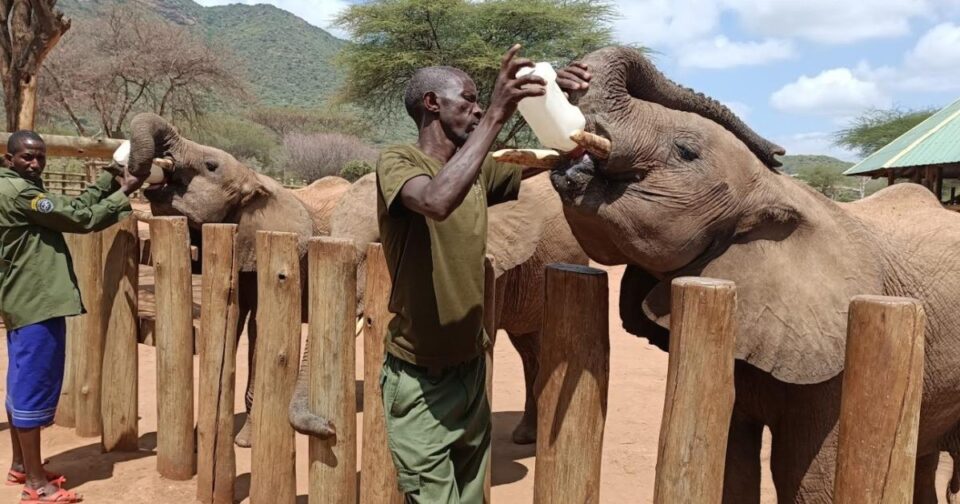
Currently, Reteti hosts about 45 baby elephants of varying ages. They are fed goat milk every three hours, day and night, mixed with supplements including moringa, honey, vitamins, algae and coconut oil.
“Goats and elephants browse the same trees, which is why goat milk works well nutritionally,” Lenanyokie notes.
The Samburu community benefits directly from the sanctuary through employment of over 120 keepers, while 60 per cent of tourism revenue supports schools, bursaries and development projects.
However, sustaining operations remains a challenge. To help, World Animal Protection has partnered with Reteti to support veterinary care, the goat-milk programme and rewilding efforts.
Research and Planning Manager Dr Patrick Muinde says the partnership enables 1,250 Samburu women to supply about 1,000 litres of goat milk daily at Sh180 per litre. The milk is boiled, refrigerated and fortified before feeding the calves.
“We believe animals belong in the wild, and Reteti’s mandate to rescue, rehabilitate and rewild aligns perfectly with our mission,” Muinde says.
The support comes as the dry season sets in, when more calves are rescued and demand for feed, water and veterinary services increases.
So far, Reteti has successfully released 26 elephants back into the wild. The sanctuary has also rehabilitated giraffes, ostriches, kudus, oryx, and previously rescued a rhino and buffalo before releasing them.
At Reteti, conservation is not only about saving wildlife, but about building a future where people and nature thrive together.
previous post
