
By SALOME MWANGI
A group of individuals close to President William Ruto, driven by unbridled determination to divide among themselves 100 acres of land in the Thika area valued at Sh20 billion, has been cited as the primary source of Governor Kimani Wamatangi’s troubles.
Investigations by The People Tribune has established that a section of the MPs close to the President has been baying for the 100 acres of land in Thika surrendered to the Kiambu Municipal Council, the precursor of present day Kiambu County government by Delmonte Kenya Limited.
Wamatangi has himself previously blamed the wrangles between him and a section of the MPs on alleged attempts to seize the public land in Thika surrendered by the food processing company Del Monte.
The President’s allies are also reportedly frustrated with the governor for allegedly standing in the way of their efforts to influence the awarding of lucrative road construction contracts to companies directly connected to them or their associates.
Many are the times Wamatangi has received public humiliation from of the President’s allies in the presence of the head of state only to be saved by members of the public who have always given him a rousing welcome at any public function.
Having failed to have their way, the group spearheaded by Leader of Majority in the National Assembly Kimani Ichung’wah and Thika MP Alice Ng’ang’a has been at the forefront trying to get rid of the governor through any means earning themselves enmity with Members of the County Assembly (MCAs) and voters in the county.
Within a span of two weeks, Wamatangi has been on the receiving end as the state appeared to unleash its machinery on him in a purported move aimed at fighting corruption and land grabbing.
But behind the government’s alleged spirited efforts lurk political maneuvers aimed at containing governors in Mount Kenya who are feared to have independent minds and oppose the grabbing of public land.
Kiambu County Assembly Majority Leader Godfrey Muceke and Deputy Speaker John Njiru were blunter, claiming that a section of local MPs were allegedly holding night meetings with a few MCAs in an attempt to push through an impeachment motion against the governor.
“It is all about the 100 acres of land in Thika and the governor’s refusal to allow them influence the award of road tenders in the county. We know their motive, Muceke roared to a cheering of crowd of Wamatangi’s supporters who had gathered outside the county offices last Tuesday.
Muceke was accompanied by more than 80 MCAs who declared to have signed a six-month declaration of confidence in Governor Wamatangi, which will take effect once the Assembly resumes from recess.
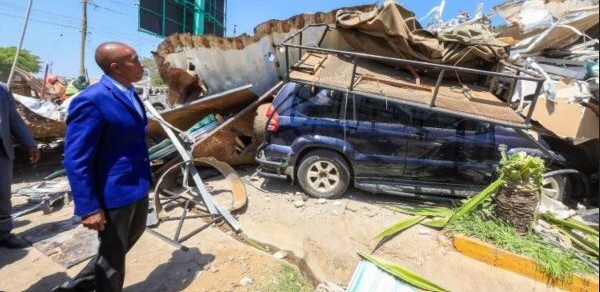
Wamatangi’s troubles that appear to have begun immediately after his election in 2022, reached crescendo this month when a contingent of more 300 police officers demolished his structures along Douglas Wakihuuri road, opposite Nyayo National Stadium for allegedly having been constructed on a Kenya Railways Corporation (KRC) land. The operation was executed despite the existence of a court order.
According to Wamatangi, a court order was in place preventing interference, but the demolition proceeded, in a move he described as political persecution.
Though KRC insisted the land belongs to them and is needed for railway expansion for projects like Afcon 2027, questions have remained on why other structures like a petrol station and a restaurant that neighbored Wamatangi’s property were spared.
Barely a week after the demolition, the Ethics and Anti-Corruption Commission (EACC) acquired court orders freezing Wamatangi’s bank accounts on alleged corruption and unexplained wealth amounting to KSh 813 million.
The EACC claims these funds were obtained through fraudulent tenders awarded by Kenya Urban Roads Authority (KURA) and Kenya National Highways Authority (KeNHA) to companies associated with Wamatangi and his family when he served as Kiambu Senator between 2017 and 2022.
But critics have questioned why only the governor’s accounts were targeted and frozen without any official from either KeNHA or KURA being put to task.
Allies of the governor and some civil society actors argue the timing and manner of the freeze point to a broader political agenda rather than a purely legal process.
They say Wamatangi has increasingly fallen out with powerful interests over land and infrastructure contracts in Kiambu, making him a target for containment. According to the critics, the governor’s firm stand against what he calls land grabbing and cartel influence in county projects has angered individuals linked to national power brokers.
“Freezing accounts is not new, but selectively doing it when a governor is politically isolated raises serious questions,” said a Kiambu-based governance activist. “It looks less like fighting corruption and more like disciplining an independent office holder.”
Supporters note that Wamatangi has publicly opposed the subdivision and transfer of large tracts of public land in Thika and Ruiru, land they claim is attractive to politically connected developers. They argue that by blocking such interests, the governor has placed himself on a collision course with influential figures who prefer pliant county leadership.
It is said that upon his election, Wamatangi noticed some notable people, including politicians had started a process to dubiously acquire the 100-acre land ceded by Del Monte after reportedly coercing former administration.
When the food processing firm eventually surrendered 695 acres, his administration gazetted 325 acres for use to establish Export Processing Zone (EPZ) edging out individuals who were eying the prime land.
“Del Monte had earlier ceded 100-acre land whose title had not been handed over to the county. When I became the governor, the county was allocated 690 more acres. Cartels including politicians started crafting a way to grab the land but I refused. I told them to write letters indicating the development projects they intend to undertake on the public land, that is when they started fighting me,” said Wamatangi recently.
Others point to lucrative road and housing tenders in Kiambu, saying the governor resisted pressure to steer contracts toward preferred firms. In recent months, Wamatangi has insisted that procurement follow competitive processes, a stance that, critics say, has disrupted entrenched networks that thrive on political patronage.
The freezing of accounts, they argue, weakens the governor administratively and politically by paralysing operations, intimidating staff and damaging public confidence, even before any charges are filed.
“It becomes punishment before trial,” said a county assembly member allied to the governor. “Once you freeze accounts and sensationalise raids, you achieve political damage whether or not the case ever succeeds in court.”
The controversy is also fuelled by the broader political climate in Mount Kenya, where several governors perceived to have independent positions have recently clashed with the national government.
Analysts say anti-graft processes, while legitimate, risk being interpreted as political tools when they appear concentrated on dissenting leaders.
