
By Nicholas Waitathu
Government’s push to formalise land ownership through issuance of title deeds and provision of critical services in 38 informal settlement schemes across the country is set to boost Kenya’s broader inspirations of sustainable urban development.
The ongoing issuance of title deeds has prompted the scheme’s occupants to invite and partner with property developers among other investors in order to modernise their buildings and provide crucial amenities.
Issuance of title deeds under the ambitious Kenya Informal Settlements Improvement Project (KISIP 2) administered by the government and development partners has further guaranteed security of the parcels of land and especially from grabbers and ownership doubts.
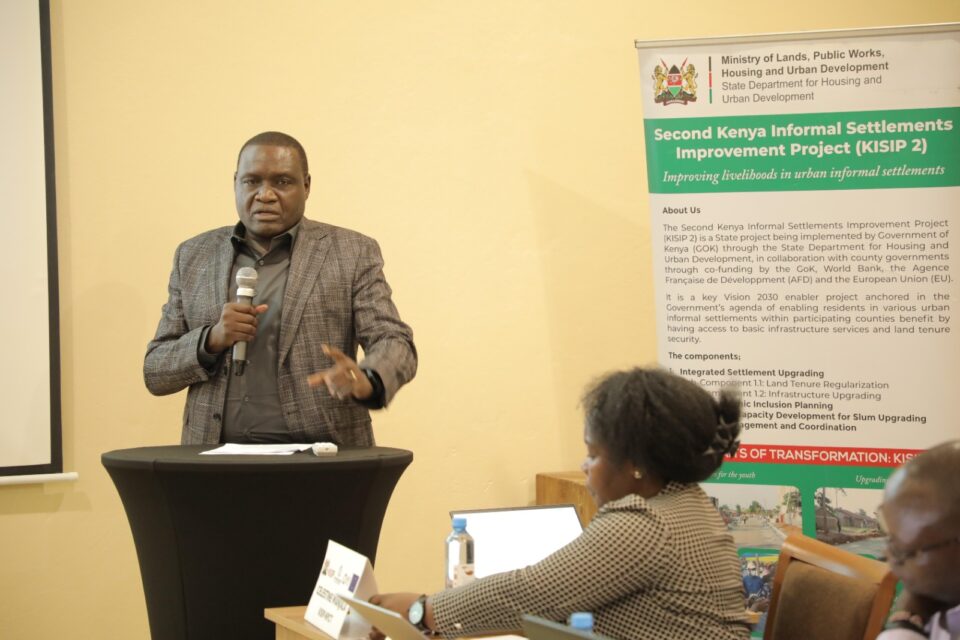
According to George Arwa, the KISIP 2 National Project Coordinator the project is domiciled in the Ministry of Lands, Public Works, Housing and Urban Development thus focusing on infrastructure upgrading, provision of essential amenities like water, drainage, electricity, and roads, improving housing quality and issuing title deeds.
Speaking during an interview in his office, Arwa stated that the informal settlements that will benefit from block title deeds have an opportunity to partner with partners like the Affordable Housing Board to modernise their buildings.
“The main focus is to drive urban development into another level by ensuring that the 38 informal settlement schemes most of which are in the outskirts of developed urban centres benefit from key infrastructure among other crucial agencies,” he said.
The KISIP 2, a Sh27.8 billion programme is financed by the Kenya government to the tune of $15 million, the World Bank ($142 million), French Development Agency (AFD) at €45 million and a €4.45 million grant from the European Union.
The selected urban informal settlements and participating counties benefit by having access to basic infrastructure services and land tenure security as well as strengthened institutional capacity for slum upgrading.
KISIP Coordinator in charge of Kiambu County Julius Mwololo noted that issuance of title deeds has opened the areas to new investors and equally enabled the inhabitants to use the documents as security when borrowing money from the local commercial banks.
“The provision of critical services has opened avenues for new investors thus increasing land value and emergence of new businesses leading also to creation of new jobs,” said Mwololo during a recent interview at Fort Jesus informal settlement scheme in Gitambaya in Ruiru of Kiambu County.
In counties of Kiambu, Embu, Kirinyaga and Nyeri which are among beneficiaries from the critical services, land prices have increased by between 87 per cent and 1,200 per cent for the last 16 years.
For example, in Fort Jesus informal settlement scheme prices of land have increased by close to 1,200 per cent from Sh1 million in 2016 for a plot of 50×100 to Sh13 Million in 2026. These are plots that original dwellers had acquired at Sh5 in the 1960s. While in Kiangombe village in Thika since 2018, property prices have increased by between 200 per cent and 400 per cent.
According to Embu County Deputy Director of Physical Planning, Nahashon Mucheru the programme is aimed at restoring dignity to residents while contributing to Kenya’s broader goals of sustainable urban development.
During a media tour in Embu recently, Kirinyaga, Nyeri and Kiambu counties, residents assured their commitment to partner with investors, for example, the Affordable Housing Board in changing the face of the settlement schemes.
The World Bank Group’s 2023 Kenya Country Climate and Development Report (CCDR) estimates that 28 per cent of Kenyans live in urban areas and the same proportion is expected to increase to 46 per cent by 2050.
Under the KISIP 2 programme, Mucheru explained, residents in informal settlements will benefit from block title deeds, quality sewer systems, roads and street solar powered lights, adding that provision of the essential facilities has excited property developers who would like to partner with the inhabitants in order to put up high-rise modern buildings.
“This programme seeks to create inclusive, safe, and sustainable cities in line with Kenya Vision 2030 and the United Nations’ Sustainable Development Goal 11 -Make cities and human settlements inclusive, safe, resilient and sustainable,” he said.
Residents in areas like Majimbo informal settlement in Manyatta sub-County of Embu County which houses over 300 people, are optimistic the new documents will help in opening up the areas to new investors to arouse new development.
“We are open to partnerships with new investors and property developers that will improve our community. The title deed process gives us hope for a more secure and better future,” Stephen Ireri, who is also Chairman of the Settlement Executive Committee in Majimbo.
Under KISIP 2, Majimbo settlement scheme established in 1993 by Plan International will soon receive block title deeds thus will help to unlock development opportunities, including potential high-rise buildings as part of the government’s affordable housing programme.
In her shop at Kiawara village in Nyeri County, Jane Wachu says government efforts to install solar street lights, fixing roads and drainage has led to improvement of business.
“Before the crucial amenities were provided, we could close our shops before 6am fearing attacks. But since they are issued with title deeds and facilities provided, we open as early as 5am in the morning and close at midnight,” said Wachu.
“We are in talks with the national government about the best ways to integrate these new developments. This is a major step towards improving living conditions and creating opportunities for better housing,” Mucheru added.
In Kiawara village in Mweiga of Nyeri County, property prices, especially plots (50 x100) since 2010 have increased by 200 per cent. This, according to Mark Thuo, a landlord in the area follows construction of physical infrastructure -roads, water, streets, and drainage systems.
“We have in recent years encountered investors scouting for investment opportunities in our area, for example, those who want to set up shopping malls, schools, private hospitals and general businesses. Even though residents are yet to start disposing of their parcels to potential investors, provision of services mainly roads and street lights, water and sewer systems has contributed to increased urban renewal,” said Thuo.
In Kirinyaga County, the majority of the informal settlement schemes were colonial set ups.
In Kiambu County, Umoja settlements scheme under KISIP 1 & 2 programme, 164 households were issued with 60 single and joint title deeds. The settlement has equally benefited from cabro roads, street lights and drainage.
“The title deeds issuance process influenced the increase in plot prices by between 87 and 150 per cent respectively. This paved the way for the entry of new investors who bought the land parcels from some of our members,” said Philip Thenge, the chairman of the settlement executive committee.
