
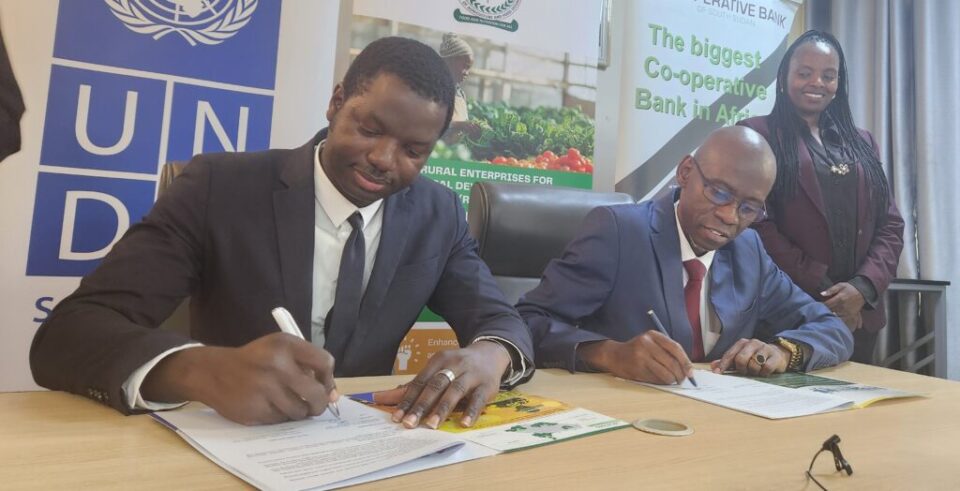
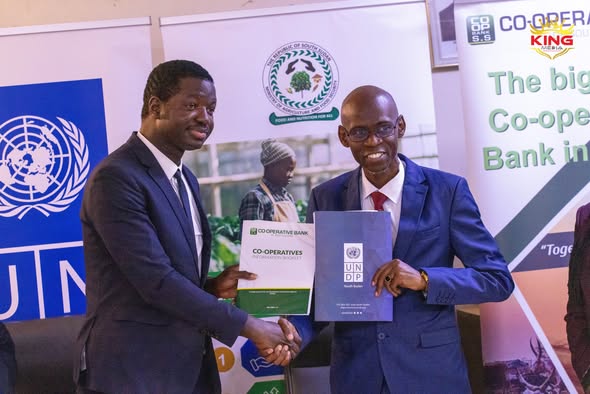
From left: Dr. Ligane Sene, Deputy Representative and Senior Economist for UNDP in South Sudan show copy of Workplan documents for a $20 million Rural Enterprise and Agriculture Development (READ) project with Elijah Wamalwa, the Managing Director Co-operative Bank of South Sudan
By John Otini
Cooperative Bank of South Sudan has tapped the United Nations Development Programme (UNDP) in what officials are calling one of the most ambitious attempts yet to bring modern finance into the country’s rural economy.
The deal, part of the multi-donor Rural Enterprise and Agricultural Development (READ) project, aims to pull thousands of small farmers, women entrepreneurs and youth-run agribusinesses into the formal financial system—many of them for the first time.
At the signing ceremony in Juba, Caroline Mwongera, the country director for the UN’s International Fund for Agricultural Development (IFAD), termed the deal a turning point. “This agreement represents a transformational step in strengthening South Sudan’s rural financial systems,” she said, noting that the READ project will use credit, cooperative development and financial literacy as tools for long-term rural transformation.
Backed by a $20 million IFAD grant and additional contributions from the South Sudanese government, UNDP, Cooperative Bank and local communities, this brings the total funding to more than $25 million.
The initiative targets 162,000 people across seven counties, with half expected to be women and 70 percent youth. Officials say the structure of the project reflects the realities of South Sudan’s farm economy, where many farmers still rely on informal savings groups, handwritten lending records and unstructured markets. In places like Aweil and Terekeka, farmers often have to travel for hours to reach the nearest formal financial institution.
A woman selling sorghum in Yambio or a youth group running a poultry project in Maridi may earn modest income but lack bank accounts, credit histories or access to affordable loans—making growth nearly impossible.
Evans Kenyi Solomon, a technical adviser at the Ministry of Agriculture, said the READ initiative puts cooperatives at the centre of fixing these gaps.
“Youth and women empowerment is not a side agenda,” he said.
“It is the engine that drives peace, prosperity, and resilience in this country.”
He described cooperatives as the missing link, explaining how farmer groups can negotiate better prices, bulk-buy inputs such as seeds or fertilizers and build shared storage facilities that reduce post-harvest losses. “A cooperative is the bridge that connects farmers to inputs, markets, and finance,” he said.
For Cooperative Bank managing director Elijah Wamalwa, the partnership is the “first major step in a journey” that began several years ago, when the bank started exploring a rural expansion strategy. He said the bank wants to ensure farmers in the interior regions can access credit as easily as someone in Juba.
Examples include expanding the agency banking network to trading centres and developing a mobile platform tailored for rural users—one that supports local languages, low-cost transactions and offline features for areas with unreliable connectivity.
UNDP officials say developments like these are essential if South Sudan is to diversify away from oil and rebuild trust in its financial system. Ligane Sene, the agency’s deputy representative and senior economist, said cooperatives give farmers bargaining power and help push the country toward food self-sufficiency.
“When farmers work in groups, they gain the power of scale,” he said. He pointed to regions like Nzara and Magwi, where clusters of cooperative-run cassava, groundnut and vegetable projects have already shown how local production can replace imports from Uganda or Sudan.
Sene added that the project could accelerate South Sudan’s shift toward a cashless economy, riding on the government’s new national payments framework. In rural markets where transactions are still dominated by cash and risk of loss or theft is high, a transition to mobile-based payments would make it easier for farmers to save securely and for banks to assess creditworthiness through digital transaction records.
The READ project will operate across Aweil, Renk, Nzara, Yambio, Maridi, Terekeka and Magwi. With a coordinated push from government, donors and the Cooperative Bank, officials believe the initiative could mark the beginning of a more resilient, productive and financially inclusive rural economy.
