
For Elias Mokaya, football was once more than a game. It was a talent that appeared to offer a way out.
Growing up in Sameta, Kisii County, Mokaya shone in school football, impressing in competitions where his skills caught the attention of those around him. But after completing secondary school, the path from school football to a professional career proved difficult to navigate.
Instead of progressing to a professional club, he found himself playing for village teams, his talent largely confined to local pitches.
“I wish my talent got a better exposure. I could be as wealthy as top global footballers such as Cristiano Ronaldo, but because that was not the case, now I am languishing here at home,” a forlorn-looking Mokaya told People Tribune in an interview.
Mokaya’s story is not about what Kenya’s first National Lottery has already delivered. The lottery is not yet operational. Rather, it illustrates the kind of untapped talent and opportunity that the National Lottery Board says its future proceeds could help support.
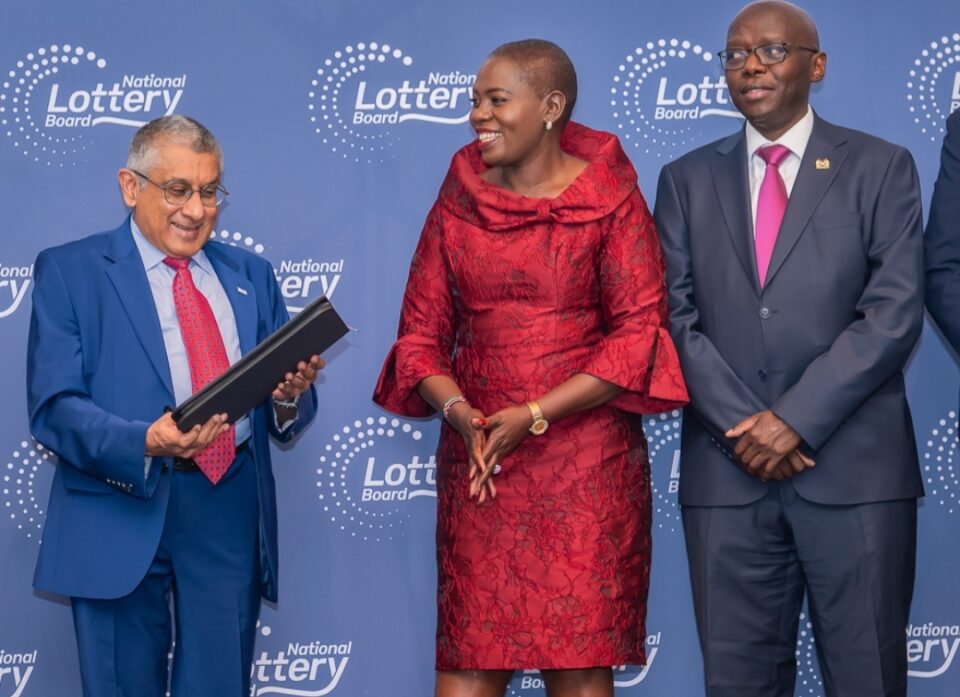
Dr. Farida Karoney, the Board Chair was emphatic that the National Lottery is not simply about lottery games, but a national instrument for good.
“Under the law, the proceeds of the National Lottery — after prizes and the cost of running the lottery — are paid into the National Lottery Fund and dedicated to good causes, and not to private benefit, board members, but to Kenyans,” she told a gathering in Nairobi on Thursday morning during the announcement of the Transaction Advisor for Kenya’s National Lottery.
Dr. Karoney explained that proceeds from the National Lottery will facilitate a bright future for a darts player who has been beating everyone in his local for years, meaning that now has somewhere to play beyond it.
At the same time, a skater on a board he built himself, will be able to get a better one and a coach.
“This means that a young welder whose skill finally covers the rent; a musician who stops giving her music away for free, and a community hall that gets built, in a place that waited a long time for one,” she added.
Subsequently, it is emerging that Kenya is moving closer to its first national lottery, but the biggest prize may not be the jackpot, but illustratively if Mokaya’s case would be used as a benchmark, it could mean the public value generated from the millions of shillings Kenyans will spend on tickets. And this will depend on whether the government gets this deal with the lottery operator right.
And this follows the appointment of a consortium led by RSM Eastern Africa and Sweden’s QLOT Consulting as Transaction Advisor, marking a major step toward selecting the company that will eventually run the lottery.
To many Kenyans, the appointment may sound like another government procurement process. But behind the technical language of concession structures, financial modelling, tender documents and cybersecurity standards lies a question that matters far beyond the boardroom: what will happen to the money generated when Kenyans begin buying lottery tickets?
Under the model outlined by the Board, proceeds from the lottery, after prizes and the cost of running it, will flow into the National Lottery Fund and be dedicated by law to good causes. These include sports, economic empowerment, arts and culture, health and education, emergency response, national heritage and transformative national projects.
Dr. Karoney further noted that all these means safeguarding the country’s heritage — the languages, sites, and memory — kept for the next generation.
“It means help arriving faster when floods or drought or fire strikes a community. And it means the country able to fund transformative projects that would otherwise wait years for a budget line,” she emphasized, pointing out that those are the categories the law has directed the Board to expedite; charitable and humanitarian causes, economic empowerment, sports, arts and culture, national heritage, health and education support, emergency response, and transformative national projects.
For young people like Mokaya, the sports component is perhaps the most tangible promise.
Mokaya knows that gap firsthand.
His journey stalled after school, leaving him dependent on local football and wondering what might have happened had his talent received greater exposure.
“I could be as wealthy as top global footballers,” he says.
That may sound like the frustrated dream of one footballer. But across Kenya, thousands of young people compete in poorly equipped fields, community grounds and school teams hoping that someone will notice them.
The National Lottery Board says the Fund is intended to help change some of those odds.
But the money will not start flowing immediately. The Board says the Fund will be capitalised from lottery proceeds and that applications for support will only open once the lottery is operational and the grant-making framework has been published.
That makes the decisions being taken now important.
The Transaction Advisor will help determine how Kenya procures and contracts the lottery operator. Its responsibilities include concession structuring, legal and regulatory advice, financial and commercial modelling, technical and cybersecurity standards, market engagement, tender preparation, evaluation support, contracting, financial close and launch readiness.
In simple terms, the adviser is helping design the machinery through which the lottery will operate before the first ticket is sold.
That machinery could ultimately determine how much value Kenya gets from the lottery — and how effectively the proceeds reach the people and communities the Board says they are intended to serve.
The Board says allocations from the National Lottery Fund will be rules-based, competitively assessed, geographically equitable, independently audited and publicly reported. It intends to disclose what was raised, what was allocated, who received the money, where they were located and what the funding achieved.
For Mokaya, the promise is personal.
He has already experienced what happens when talent meets opportunity only halfway.
The question now is whether Kenya’s new lottery can help ensure that the next Mokaya gets a different chance — not necessarily to become the next Cristiano Ronaldo, but at least to have access to the equipment, coaching, exposure and pathways that allow talent to become a sustainable livelihood.
And that is ultimately where the success of the National Lottery may be judged.
The Board says geographical equity will be a design principle of the Fund: the whole country will contribute and the whole country is intended to benefit. Dr. Karoney explained that the allocation will be rules-based and governed by regulations and will be competitively assessed, besides responding to geographical equity, because the whole country contributes.
“So, the whole country must benefit. It will be independently audited. And it will be publicly reported, so that any Kenyan can see where the money went and what it achieved,” she stated, noting that is the promise upon which the Board should be held accountable to.
For young footballers on dusty pitches in Kisii and elsewhere, that promise is still just that — a promise.
But for Mokaya, it represents a question he has lived with for years: what might have been possible if talent had been matched with opportunity?
Kenya’s first national lottery is now being designed. Its real test will come when the money begins to move.
