
By PEOPLE TRIBUNE REPORTER
A legal dispute over who has the constitutional authority to promote and dismiss police officers has begun to expose serious cracks in command and discipline within the National Police Service, with security experts warning that the uncertainty could have far-reaching consequences as the country enters another politically sensitive period.
The February decision by the Court of Appeal to temporarily suspend the implementation of a judgment giving the Inspector-General exclusive authority over the promotion and dismissal of police officers has created a leadership and administrative vacuum that is increasingly being felt across the Service.
The suspension has not only slowed promotions and confirmations of deployments but has also left officers who have been found guilty of serious disciplinary offences waiting for the conclusion of cases that could determine whether they remain in the Service.
Sources within the National Police Service say the situation has resulted in a growing backlog of promotions, with some officers reportedly waiting for decisions dating back nearly a year.
Others whose deployments and other administrative decisions require formal confirmation have also been left in limbo as the Service awaits further directions from the courts.
More worrying, according to officers familiar with the disciplinary process, are cases involving personnel who have already gone through Orderly Room Proceedings and were found guilty and recommended for dismissal.
Some of these officers remain in the Service because the dismissal process cannot be concluded until the legal dispute surrounding the powers of the Inspector-General and the National Police Service Commission is resolved.
Security experts say the situation risks weakening one of the most important pillars of policing—certainty that misconduct will attract swift and appropriate sanctions.
“A police officer who believes that the Service presently has limited ability to impose the ultimate sanction of dismissal may calculate that the consequences of serious misconduct have become less immediate or certain,” a senior officer said.
The officer warned that the uncertainty could reduce deterrence against serious misconduct, encourage the accumulation of disciplinary cases and result in the prolonged retention of officers who would ordinarily have been removed from the Service.
It could also increase the burden on commanders and supervisors who continue to oversee officers whose disciplinary cases remain unresolved.
Sources within the Service said the situation has contributed to low morale, stagnation in rank, confusion within the chain of command and a growing number of pending administrative matters awaiting direction.
“This not only demoralises disciplined officers but results in delays in resolving cases involving corruption, gross insubordination, desertion, violence or other serious offences, including murder,” the officer said.
“For a disciplined organisation such as the NPS, certainty and timeliness of disciplinary sanctions are important elements of command authority.”
The dispute stems from a ruling delivered by the Employment and Labour Relations Court (ELRC) on October 30, 2025, which held that the National Police Service Commission (NPSC) does not have constitutional authority over the recruitment, promotion and dismissal of members of the National Police Service.
The court ruled that the powers fall under the independent command of the Inspector-General and the National Police Service.
The decision triggered a legal battle, with the Law Society of Kenya (LSK) challenging the ELRC decision before the Court of Appeal.
In February this year, a three-judge bench of the Court of Appeal comprising President Daniel Musinga, Mumbi Ngugi and George Odunga temporarily suspended the contested portion of the ELRC judgment pending the hearing and determination of the appeal.
The effect of the interim order was to place the exercise of the disputed powers on hold, creating uncertainty over the administrative mechanisms governing promotions, dismissals and other personnel decisions within the Service.
The legal uncertainty comes at a particularly sensitive time for the police, with the country heading towards the 2027 General Election and the National Police Service expected to play a central role in maintaining law and order.
Security experts say a police command structure perceived to be unable to swiftly deal with misconduct could undermine discipline at a time when officers will be required to operate under intense political and public scrutiny.
The concerns have been amplified by a series of cases in which serving police officers have been accused of serious crimes.
Latest reports indicate that scores of officers have been arrested, investigated or charged in connection with offences ranging from murder and robbery with violence to kidnapping.
Investigations have also linked some officers, particularly in Nairobi and its environs, to alleged armed robbery syndicates in which victims are forced to transfer money from their M-Pesa and bank accounts.
Among the latest cases is that of Constable Charles Maulo of Kayole Police Station, who was arrested on Tuesday over the alleged abduction of Emmanuel Kerich, a medical doctor at Kiambu County Referral Hospital.
Kerich was reportedly abducted at Juja City Mall along Thika Superhighway, where his captors allegedly demanded a Sh3 million ransom.
The arrest has renewed concerns about the involvement of serving officers in organised criminal activities and the difficulty of maintaining public confidence when those accused of serious crimes are themselves members of the institution mandated to protect citizens.
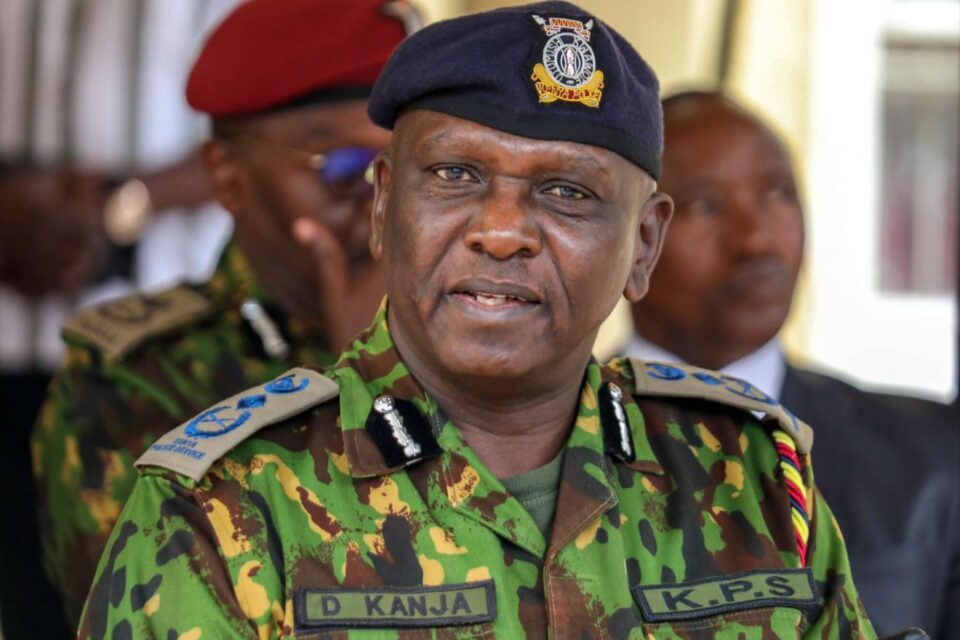
Inspector-General of Police Douglas Kanja has condemned such cases, describing the involvement of police officers in criminal activities as a serious betrayal of public trust.
Kanja said officers take an oath to protect Kenyans and should never turn their weapons against the very people they are mandated to serve.
“My position is that all criminals must be firmly dealt with whether in uniform or not. None is above the law. Remember we are over 100,000-plus officers; it is equally true that every market has a madman and, in our case, those are some of the rotten apples,” Kanja said.
The Inspector-General’s remarks come against a backdrop of several ongoing investigations involving serving officers.
Last week, Inspector Kelvin Mwangi and Stephen Okello Obewa were arraigned before the Makadara Law Courts on two counts of robbery with violence.
Obewa reportedly told investigators that several serving police officers were involved in the alleged criminal syndicate, claims that are expected to form part of ongoing investigations.
In another high-profile case, detectives arrested Constable Elijah Kibelion Kimoi in connection with the murder of Dr Victoria Nthunya Mutiso.
Police are also pursuing two other officers allegedly linked to the killing—Inspector Kenneth Kipkemboi Sang of Nderi Police Post and Constable Collins Bett Kiplangat of Thogoto Police Station.
The cases have raised questions about whether existing internal disciplinary mechanisms are sufficiently swift and effective in dealing with rogue officers, particularly when criminal investigations and administrative proceedings run concurrently.
Under the current uncertainty, disciplinary and criminal proceedings may take considerably longer to conclude, creating a difficult situation for commanders who must balance the rights of accused officers with the need to maintain discipline and public confidence.
The problem is further complicated by the fact that a finding of guilt in an internal disciplinary proceeding and a criminal conviction are distinct processes, with different evidentiary thresholds and legal consequences.
Police officers facing criminal allegations are therefore entitled to due process, just as they are entitled to challenge administrative decisions affecting their careers.
However, security experts argue that due process should not be confused with administrative paralysis.
They say the Service must have a clear, constitutionally compliant mechanism through which serious misconduct can be dealt with promptly while protecting the rights of officers accused of wrongdoing.
The unresolved question of who exercises the ultimate personnel powers over the police is therefore likely to remain a major institutional issue until the Court of Appeal determines the LSK challenge.
In the meantime, commanders face the difficult task of maintaining discipline in an organisation where some officers are awaiting promotions, others are challenging disciplinary decisions and some accused of serious offences remain under investigation or in active service.
With the 2027 elections approaching, security experts say the need for clarity has become even more urgent.
They warn that prolonged uncertainty over command and disciplinary authority could weaken morale among law-abiding officers, embolden rogue elements and place additional pressure on senior commanders already grappling with rising public scrutiny over police conduct.
The outcome of the appeal could therefore have implications far beyond promotions and dismissals. It may ultimately determine how authority, accountability and discipline are exercised within Kenya’s police service.
