
By WILLIAM INGANGA |
@trbnreporter
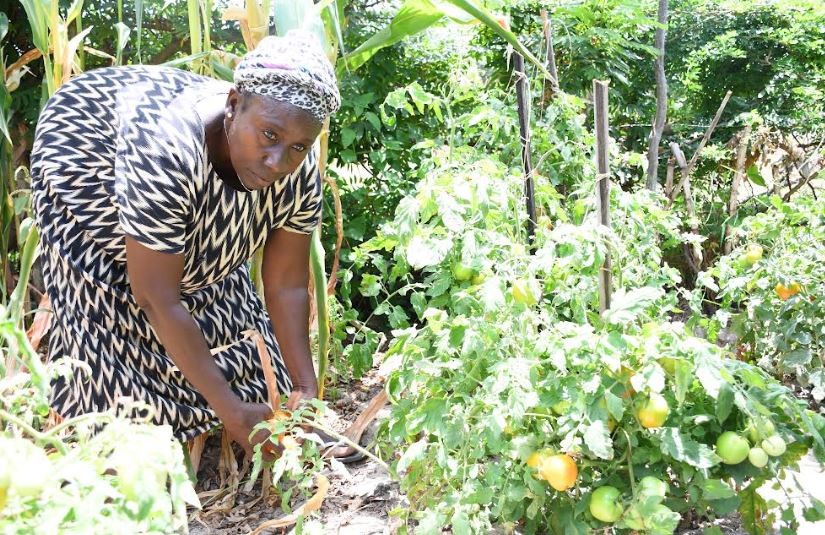
From a patch of sunbaked land in Magarini, Kilifi County, Loice Kaingu has cultivated more than food; she has grown confidence, income, and a renewed sense of purpose.
Each morning in Mjanaheri village, the mother of three sorts through buckets of ripe tomatoes, amaranth, spinach, and sugarcane. Nearby, a small flock of chickens clucks noisily under the intense sun, a sign of a livelihood slowly taking root. The produce, once grown haphazardly and sold without planning, now represents a carefully nurtured income stream, allowing her to support her family and contribute to household decisions.
“Farming pays,” Kaingu says with a smile, wiping sweat from her brow. “We’ve been taught to look for markets, near and far. I didn’t know I could plan like this before.”
Kaingu is among about 2,000 farmers across Kilifi County benefiting from Tushauriane Schools, a community-led initiative described as “schools without walls.” These informal learning hubs bring farmers together weekly to exchange ideas, test improved farming methods, and jointly solve challenges that smallholders face.
The initiative operates under the mantra Tushauriane, Tuimarishe Kilimo Biashara (“Let’s Discuss to Strengthen Agribusiness”) and is supported by the Food and Agriculture Organization of the United Nations (FAO) through its Flexible Voluntary Contribution Sub-Programme. Implementation involves a multi-partner collaboration with Centre for Behaviour Change and Communication (CBCC) Africa, Pwani University, and Amplio Ghana, blending practical farming knowledge with social and behavioral interventions.
The program combines Women’s Empowerment–Farmer Business Schools (WE-FBS) with Social and Behavior Change Communication (SBCC) approaches. Participants also benefit from Amplio Talking Books, audio devices that deliver lessons on farming, finance, and social behavior directly into households. In this way, learning continues at home long after the weekly sessions end, creating a ripple effect within communities.
Across Kilifi North, Kilifi South, Magarini, and Ganze sub-counties, 80 farmer field schools are actively engaged, each bringing together between 25 and 30 smallholder farmers, the majority women. Farmers learn by doing—experimenting, observing results, and making collective decisions.
Before joining the Tushauriane School, Kaingu planted crops without a structured plan and sold whatever survived. Today, she and her husband carefully organize their farm, dividing it into sections for vegetables, legumes, and poultry feed, while keeping detailed records of sales and expenses.
“When I come home from the sessions, I explain what we’ve discussed,” she says. “Now my husband supports me. We plan together, and he even helps take produce to the market. Farming has become a family project, not just my responsibility.”
Facilitators guide farmers through 24 structured sessions covering farm planning, market mapping, financial literacy, and gender equality. The program does more than teach agricultural techniques—it encourages farmers to reflect on family dynamics, gender roles, and decision-making processes, creating lasting social change alongside economic improvement.
In a region where water scarcity often limits agricultural productivity, particularly for women, Kaingu remains determined. “Our biggest challenge is lack of water,” she says, pointing to a dry borehole near her home. “But I still irrigate using water we buy or fetch from the stream. My children help after school. It’s hard work, but it pays off.”
Her determination is beginning to yield tangible results. Kaingu now sells vegetables to local traders and neighbors, using part of her earnings to pay school fees and meet household needs. “I used to grow just enough to feed my family,” she explains. “Now I farm to earn an income as well. That’s what learning has done for me.”
“This project helps farmers reframe their challenges,” says Husna Mbarak, Land Governance Programme Manager and Governance and Social Inclusion Team Lead at FAO Kenya. “By combining skills training with reflection, it changes how people think about farming, family roles, and fairness. It empowers women while encouraging men to share responsibilities at home and in business.”
At the heart of Tushauriane Schools is dialogue. Weekly sessions encourage men and women to openly discuss roles, workloads, and decision-making—subjects that were once considered taboo. “We’re seeing women manage budgets, keep records, and plan group businesses,” says Hellen Collete, Project Coordinator at CBCC Africa. “They’re not just learning to farm better; they’re learning to lead, negotiate, and make decisions that affect their families and communities.”
Dr. Lenard Mounde, a senior lecturer at Pwani University, notes that the approach is gradually shifting long-held social norms. “When men, women, and youth share responsibilities, productivity improves and communities benefit as a whole,” he says. “It’s not just about agriculture; it’s about reshaping how people relate to each other while building sustainable livelihoods.”
From a global perspective, FAO officials emphasize that the Kilifi pilot offers valuable lessons for scaling agricultural interventions. “The project strengthens agribusiness skills, particularly for women, while improving market linkages,” says Huda Alsahi, FAO Social Policy Officer based in Rome. “Even within a short period, we’ve seen that when partners work together and communities take ownership, transformation happens.”
Community response to the program has been overwhelmingly positive, with farmers embracing the methods and expressing willingness to invest their own resources to sustain improvements. Beyond financial benefits, participants report enhanced confidence, improved family communication, and a renewed sense of dignity.
Although the one-year initiative is nearing conclusion, its impact is expected to endure. Kaingu, her children, and neighbors continue to experiment with crops, adapt lessons learned, and apply newfound knowledge. The pilot demonstrates that when farming techniques are combined with social empowerment and continuous learning, rural communities can achieve meaningful, long-term change.
As the sun dips behind the coconut trees, Kaingu’s children return from school to help water the rows of green vegetables. Each droplet of water is a testament to resilience, determination, and the power of learning. In Kilifi’s schools without walls, education has grown far beyond the classroom—it has taken root in the soil, in households, and in the very heart of the community.
