
By PT Reporter
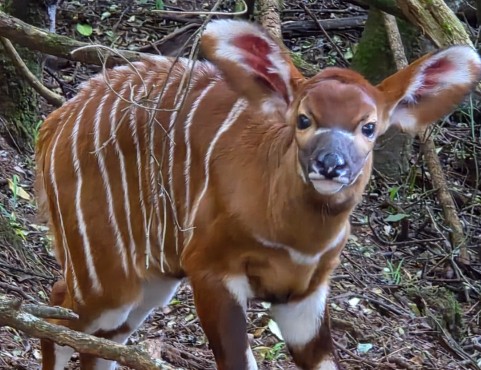
At slopes of Mount Kenya, when the mist still hangs low and the air smells of damp earth and cedar, a small life took its first, careful steps. The calf was unsteady, blinking into a world that has not always been kind to its kind. But this birth carried a weight far beyond its fragile legs. It was the 100th Mountain Bongo born under the decade old Mount Kenya Wildlife Conservancy’s Breeding and Rewilding Programme.
For lovers of nature and wildlife, and especially conservationists who have devoted their careers to saving the Mountain Bongo from extinction, the moment was emotional. This antelope, instantly recognisable by its rich chestnut coat, white stripes and elegant spiral horns, once roamed freely across Mount Kenya, the Aberdares and Eburu forests. Over time, habitat loss, encroachment and relentless poaching pushed it to the edge. Today, fewer than 100 are believed to remain in the wild.
That is what makes this single birth so powerful. It is not just another addition to a breeding register; it is a marker of hope, proof that patient, often invisible work can reverse even the most desperate declines.
“This reflects more than 20 years of dedication,” said Kenya Wildlife Service Director General Prof. Erustus Kanga, acknowledging the scientists, veterinarians, rangers and wildlife managers who refused to give up on the species. For KWS, the milestone reinforces the belief that long-term partnerships — rather than quick fixes — are what truly save wildlife.
The road to this moment began far from Mount Kenya. In 2004, 18 Mountain Bongos were repatriated from the United States to Nanyuki, forming the foundation of what would become one of Africa’s most ambitious species recovery programmes. At the time, the idea of rebuilding a viable population seemed daunting. Breeding a notoriously sensitive animal requires precision: genetics must be carefully managed, stress minimised, habitats restored and human interference kept at bay.
Slowly, calf by calf, progress came. In 2022, another turning point arrived with the opening of the Mawingu Mountain Bongo Sanctuary — the world’s first wild sanctuary dedicated solely to the species. Set within a secure, natural environment, Mawingu allows Bongos to relearn the rhythms of the wild, preparing them for eventual reintroduction into their historic ranges.
For Humphrey Kariuki, Patron of Mount Kenya Wildlife Conservancy and IUCN Patron of Nature, the 100th birth is both a reward and a responsibility. “This milestone reflects decades of coordinated breeding, habitat restoration and community engagement,” he said. “Our goal is not just to protect Bongos behind fences, but to return a healthy, self-sustaining population to the wild.”
That vision extends beyond animals alone. MKWC’s work is woven deeply into the surrounding communities. Each year, more than 30,000 students pass through the Conservancy’s education and empowerment programmes, learning that conservation is not an abstract concept but a living relationship between people, forests and wildlife. Through school visits, adoption programmes and habitat restoration projects, conservation becomes personal — something worth defending.
Dr. Robert Aruho, Head of Conservancy at MKWC, describes the milestone as both celebration and challenge. “It gives us momentum,” he says, “but it also reminds us how fragile success can be. Recovery is not guaranteed unless we remain vigilant.”
Behind the scenes, the effort is sustained by a web of partnerships — with Kenya Wildlife Service, Kenya Forest Service, international conservation bodies such as Chester Zoo, EAZA and IUCN, as well as corporate and individual supporters who fund the unglamorous but essential work of conservation.
As the young calf settles beside its mother, unaware of the symbolism it carries, its existence tells a larger story about Kenya’s natural heritage. It is a reminder that extinction is not inevitable, and that recovery — though slow and demanding — is possible when commitment outlasts crisis.
The Mountain Bongo, however, still walks a narrow line between survival and loss. But with 100 calves born and counting, that line kay be shifting.
