
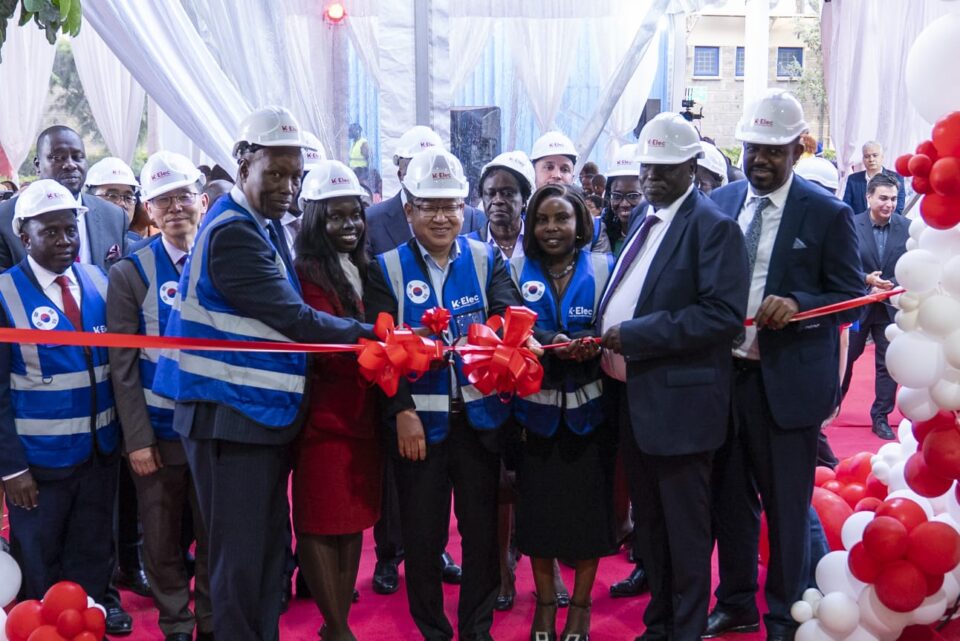
Kenya’s bid for local manufacturing has been boosted by the unveiling of an assembling plant for production of home appliances in Syokimau, Mavoko subcounty, Machakos.
K-Elec Kenya, a subsidiary of the Seoul-based Korean technology company KElec, has officially launched its new electronics assembly factory at Sarin Industrial Park, Godown 4, Syokimau. This, according to Investments, Trade and Industry Cabinet Secretary, Lee Kinyanjui, marks a significant milestone for Kenya’s manufacturing sector.
“Strengthening local manufacturing is the only sustainable path,” said Kinyanjui who has been vocal on local manufacturing, maintaining that no country can grow through imports alone.
The event brought together other key government and diplomatic leaders, underlining the importance of this particular investment to Kenya’s industrial agenda.
“This agenda focuses on turning the nation into a newly industrializing country by boosting manufacturing’s GDP contribution to 15-20 percent by 2030,” said the CS who highlighted that this will be achieved through infrastructure – County Aggregation & Industrial Parks – digitalization, greening industries, value chain development for example agriculture, textile, and leather; supporting MSMEs, and attracting investment, aiming for shared growth and job creation.
The launch was graced by, Kang Hyung-shik, the Ambassador of the Republic of Korea to Kenya, Principal Secretaries; John Tanui (ICT and the Digital Economy}, Belio Kipsang (Immigration and Citizen Services), and Abubakar Hassan (Investment Promotion).
Their presence also demonstrated the strong partnership between Kenya and Korea in advancing technology-driven manufacturing.
The grand opening of the factory marks the first time K-Elec products will be assembled on Kenyan soil. This is seen as a move to unlock faster production timelines, reduced consumer costs, and increased access to high-quality electronics.
David Lang’at, K-Elec Chairman and Co-founder said that the unveiling of the factory is a strategic investment in Kenya’s industrial future, which represents a strong vote of confidence in Kenya’s economy, that aligns with the national agenda of boosting foreign direct investment, creating skilled jobs, and strengthening local manufacturing capabilities.
“K-Elec’s expansion into Kenya is a long-term commitment to Kenya’s industrial growth, and with our slogan ‘Korean Tech, Kenyan Trust’, we are merging world-class Korean engineering with local expertise to deliver reliable, accessible, and innovative home appliances for Kenyan households,” he said.
The Syokimau plant is expected to create new employment opportunities across manufacturing, engineering, quality control, logistics, and after-sales service. K-Elec also announced plans for ongoing skills development programs, offering Kenyan technicians access to specialized Korean-led training in modern assembly technologies.
“This demonstrates the long-term vision of job creation and skills transfer, whereas local assembly means affordability for Kenyan consumers by shifting production closer to the market,” Lang’at said, emphasizing that K-Elec aims to significantly reduce shipping costs and delivery times.
He noted that this translates directly into more affordable premium electronics for Kenyan consumers without compromising on the brand’s globally recognized Korean standards.
“Strengthening Korea–Kenya Trade Relations K-Elec’s investment reinforces the growing economic cooperation between Korea and Kenya, particularly in technology, manufacturing, and innovation,” he added.
The company is exploring additional opportunities to expand its product line and introduce new smart-home innovations now that assembly operations have begun locally.
“With its new presence in Kenya, K-Elec is committed to making premium electronics more accessible, inspiring, and trusted across the region,” Lang’at pointed out.
The government policy on local manufacturing, focuses on boosting domestic production through incentives, import duty adjustments, and creating an enabling environment to reduce reliance on imports, enhance job creation, and achieve self-sufficiency, especially in critical sectors like health (pharmaceuticals) and automotive, aiming for significant GDP contribution by 2030.
