
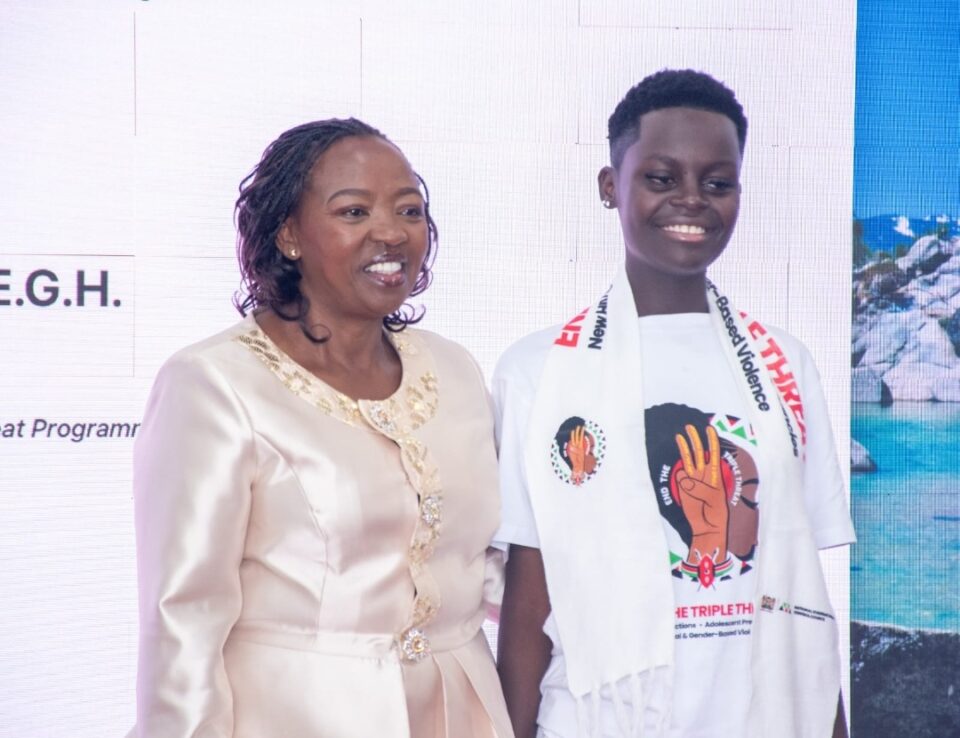
From teenage pregnancy to HIV: Farida’s story puts a human face on Kenya’s ‘Triple Threat’
By George Kebaso
At 19, Farida Adero has already lived through experiences that policymakers are now warning could derail a generation of Kenyan young people: teenage pregnancy, sexual gender-based violence, poverty and HIV.
Her story began when she was just 15.
Farida was helping her mother survive by doing laundry and taking on other casual jobs because her family struggled to raise money for her school fees and food. This is from her testimony in a gathering attended by First Lady Rachel Ruto in Nairobi this week.
When the work became scarce, the pressure to contribute to the family’s livelihood intensified, and at that tender age, she took a personal initiative to contribute in order to minimize her mother’s struggle.
“My mother was really struggling to pay my school fees and put food on the table for us,” she told an attentive audience.
But the jobs eventually dried up, leaving the family struggling to survive. Desperate to contribute to the household, Farida looked for other ways to make money.
Then she became pregnant.
She left home and moved in with the young man responsible for the pregnancy, hoping the relationship would provide some stability. Instead, it became another source of danger.
His parents did not accept her, and eventually the young man turned against her.
“He would come to the house and start beating me. He would hit me against the wall,” she recalls.
During one assault, he struck her in the back with a glass bottle. The injury was serious enough to require an X-ray, which revealed a fracture.
Neighbours eventually took her back to her mother.
Days later, Farida developed severe abdominal pain. At hospital, doctors told her she had miscarried and needed a procedure to clear her womb.
She was only 15.
“I was so young and had never experienced such things. It was such a painful experience. For a whole month, I nursed the pain,” she says.
But returning to her mother’s home did not end the struggle.
Her mother continued looking for casual work. Her father, a painter, had no steady income. When the family’s few sources of income dried up again, Farida was forced to look for ways to earn money.
She went to Nairobi Central Business District (NCBD) with friends after they told her about a job opportunity.
When she arrived, she discovered that the work was prostitution.
She stayed.
“While in town I realized the job I was told was none but prostitution, so I found myself in it,” she testified.
For about a month, Farida says, she earned Sh500 from men who used condoms and Sh1,000 from those who refused.
“Most of the men did not use condoms,” she says.
Then came the diagnosis that changed how she understood her own vulnerability.
One day, while walking around her estate, Farida and her friends came across a free medical camp. They decided to go in and get tested for HIV after the mobilisers encouraged them.
The decision appeared almost casual. Moments earlier, they had been talking about HIV and reassuring one another that they could not possibly have the virus, and Farida was the most vocal, expressing strong sentiments against the disease.
Ironically, she was the first to go in for the test.
The test showed two lines.
She asked the health worker whether the test was for pregnancy or HIV.
“He told me it was HIV,” Farida said as she allowed to undergo the test three times to confirm the result.
By then, Farida was so weak that she could barely stand.
Health workers counselled her and explained that people living with HIV could still live long, healthy lives and thrive socially and economically if put on treatment. But the diagnosis was difficult for her to process.
“All this time my mind was racing. I knew I was dying,” she says.
Her mother was contacted and took her to hospital for a second opinion. The result was confirmed.
Farida started antiretroviral treatment and medication to prevent tuberculosis.
The drugs came with severe side effects, but she persevered.
She completed the TB-prevention treatment and continued with her antiretroviral medication.
Today, Farida says she considers herself healthy.
She still does laundry and has taken up hair braiding to earn a living.
“I see myself as just a normal, healthy person going about my duties,” she says.
Her story has now become part of a much larger national conversation.
At a national dialogue on Kenya’s “Triple Threat” — new HIV infections, adolescent pregnancy and sexual and gender-based violence — officials repeatedly invoked the experiences of young people like Farida to demonstrate that the three problems cannot be treated as separate crises.
“Farida is a typical example of why we need to end the triple threat in Kenya,” Dr. Richard Amenya, the newly appointed Country Director and Country Representative of the Joint United Nations Programme on HIV/AIDS (UNAIDS) told the gathering.
And the numbers help explain why, he added.
According to the National Syndemic Diseases Control Council (NSDCC), Kenya recorded 13,936 new HIV infections in 2025. Among new infections in people aged 15 and older, 41 percent occurred among adolescents and young people aged 15 to 24.
The Council’s Chief Executive Officer, Dr. Douglas Bosire said that when the age range is expanded to 15 to 34, young people accounted for 72 percent of new infections.
“The country is also confronting a persistent adolescent pregnancy crisis,” he said, and shared more statistics.
More than 236,000 girls aged 10 to 19 presented at health facilities with pregnancies in 2025, according to data presented at the meeting. That translates to roughly 640 girls every day.
“Ladies and gentlemen, these are 640 children who should be in school, but were instead turning up for maternity care,” Bosire added.
Behind those numbers are stories like Farida’s.
Her experience demonstrates how one vulnerability can feed another, the gathering nodded digesting the reality.
And Farida’s testimony was summarized.
Poverty pushed her to seek work. Teenage pregnancy disrupted her childhood and education. Violence placed her in physical danger. Economic insecurity later left her vulnerable to transactional sex, where she had limited ability to negotiate condom use. HIV followed.
Officials argue that this interconnectedness requires a different response.
“The triple threat is driven by interconnected vulnerabilities,” the First Lady said. The national dialogue was a culmination of a tour of four counties; Samburu, West Pokot, Homa Bay and Uasin Gishu under the Voice of Children Initiative championed by the Office of The First Lady.
The First Lady piloted the programme in Meru and Narok counties before launching its second phase in September 2025, extending it to the four counties in partnership with the Ministry of Health through the National STI Control Programme (NASCOP) and the NSDCC.
During the national dialogue; poverty, gender inequality, economic insecurity, limited access to essential services and weak protection systems, were identified among the underlying drivers.
That means healthcare alone cannot solve the problem.
The response must also involve education, child protection, social protection, security, justice, communities and families, various speakers including governors, particularly from the four counties, members of parliament and gender activists, voiced their concerns.
Kenya has made significant progress against HIV. Between 2015 and 2025, new HIV infections fell by 82 percent, according to data presented at the meeting.
But officials warned that the remaining infections are increasingly concentrated among vulnerable populations, particularly adolescents and young people.
“The government is therefore calling for intensified HIV prevention, adolescent-responsive health services, stronger responses to sexual and gender-based violence, measures to keep vulnerable young people in school and more targeted use of data and resources,” Public Health and Professional Standards Principal Secretary, Mary Muthoni said.
The economic argument is equally stark.
Dr. Amenya said an investment case showed that every $1 (Sh129) invested in sexual and reproductive health for girls could generate a $24 (approximately Sh3000) return.
“The Triple Threat is real, and it could cost Kenya $1.2 billion annually, equivalent to 1.1 percent of the GDP, if the country fails to invest in addressing girls’ education,” he added.
The implication is that protecting girls is not simply a social or health intervention. It is an economic investment.
“At the UN, we believe that if we are able to get girls to stay in school, they are definitely going to avoid HIV. About 11 percent of them will avoid HIV, and then they are not also going to get early pregnancies and ultimately will not be abused.
“We also believe that this is the right development investment for Kenya and the United Nations is here to support you.,” Dr. Amenya said.
For Farida, however, the issue is much more immediate.
She knows what it means when poverty limits choices. She knows what happens when violence is allowed to continue. She knows how quickly a teenage pregnancy can change a young girl’s life.
And she knows the fear of an HIV diagnosis.
But she also knows that the diagnosis did not end her life.
Treatment has allowed her to regain her health and continue working.
She now watches how people talk about HIV and is troubled by the stigma she still encounters from people who believe they cannot possibly acquire the virus.
Her message is shaped by experience rather than statistics.
People who believe HIV happens only to others, she says, should understand that vulnerability does not always announce itself.
Farida’s journey is therefore both a warning and a measure of what is at stake in Kenya’s effort to end the Triple Threat.
The national dialogue ended with a call for government, counties, development partners, civil society and the private sector to turn young people’s experiences into concrete policies, budgets and services.
For Farida, the question is what happens before another 15-year-old is forced to navigate the same chain of events.
Because by the time a vulnerable girl arrives at an HIV testing centre, after pregnancy, violence and economic desperation have already shaped her choices, the system may already be too late.
The challenge for Kenya is to intervene much earlier — to keep girls in school, protect them from violence, reduce the poverty that narrows their choices, provide services they can trust and ensure that an HIV diagnosis is met with treatment rather than stigma.
Farida has survived the worst of her journey.
Now, she wants the next generation to have a different one.
