
By ADEN KIPRUTO
For nearly two decades, Kenya has travelled under a development map drawn in 2008, when President Mwai Kibaki’s administration unveiled Vision 2030 with an ambitious promise: to transform the country into a newly industrialising, middle-income economy providing a high quality of life to all its citizens.
Now, as that deadline approaches, President William Ruto wants Kenyans to pick up the pen and draw a new map — one that looks beyond 2030 and, ultimately, towards the kind of prosperous, industrialised nation that Kenyans have often watched from a distance.
Ruto’s pitch is no longer simply about completing roads, bridges, ports and other infrastructure. His latest national conversation is about something considerably bigger: defining the Kenya that future generations will inherit and laying the foundations for a country capable of competing with the world’s advanced economies.
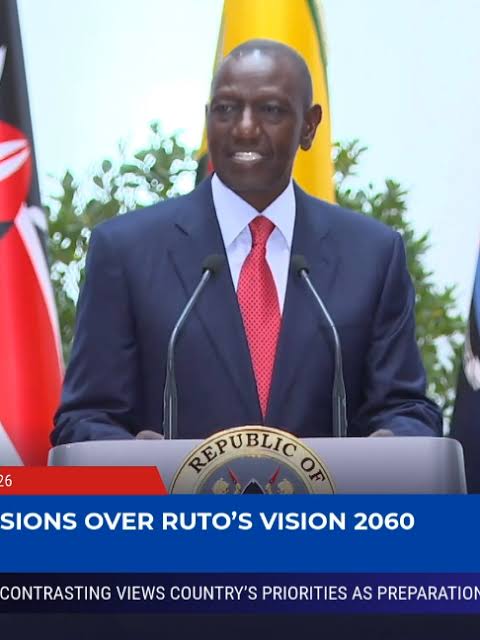
At the Beyond 2030 conversation forum at the Kenyatta International Convention Centre in Nairobi on Wednesday, Ruto placed citizens at the heart of the exercise to craft a successor to Vision 2030.
Unlike the previous blueprint, which he argued was not sufficiently owned by ordinary Kenyans, the President said the new development charter must emerge from public participation and reflect the aspirations of citizens rather than the preferences of government officials and bureaucrats.
“The reason why people don’t understand and relate to Vision 2030 is because there was no public participation to the extent provided for in the new Constitution now,” he said.
“We have an opportunity, different from the one we had in 2008 to formulate a long-term plan by the people of Kenya, not the Government, not the bureaucrats.”
The proposition is significant.
Vision 2030 was born at a very different moment. Kenya was emerging from the post-election violence of 2007-08 and the world had not yet experienced the technological revolution that would bring smartphones, artificial intelligence, digital banking and a radically transformed global economy.
The Constitution had not yet been promulgated. Devolution did not exist. Kenya had not built the Nairobi Expressway, opened Lamu Port or completed the Isiolo-Marsabit-Moyale road. Artificial intelligence was largely a subject confined to laboratories and science fiction.
Much of that has now changed.
Ruto wants the next blueprint to capture that new reality and, crucially, to protect Kenya’s development ambitions from the political upheavals that accompany every election.
“For far too long, we have made elections a matter of life and death. They are not. Kenya must think beyond the next election. Kenya must think about the next generation,” he said.
This is at the heart of Ruto’s argument that Kenya cannot become a developed country if every five years brings a wholesale change of priorities.
The President wants development to become a relay race in which one administration picks up the baton from another rather than abandoning projects and policies simply because political power has changed hands.
His administration is already presenting its own development agenda as part of that journey.
The Bottom-Up Economic Transformation Agenda has focused on agriculture, micro, small and medium enterprises, healthcare, housing and settlement, and the digital and creative economy. The Government has also pushed affordable housing, universal healthcare reforms, digital government services, infrastructure development and efforts to expand manufacturing and investment.
The broader ambition is to move the economy away from dependence on traditional sources of growth and create a more productive economy in which millions of Kenyans can earn better incomes.
But Ruto’s vision extends beyond the immediate priorities of his administration.
He is effectively asking Kenyans to imagine a country in which modern roads and airports are not luxuries, where ports operate as engines of regional commerce, where industries process Kenyan agricultural produce instead of exporting raw commodities, where technology creates millions of jobs and where healthcare, education and housing meet the standards expected in prosperous nations.
It is an ambition that has been attempted before.
Vision 2030 produced an impressive catalogue of projects, including the Lamu Port, the Isiolo-Moyale road and the Nairobi Expressway, alongside other major investments in transport, energy, ICT and urban infrastructure.
Ruto said Vision 2030 had delivered 378 landmark projects, although he acknowledged that implementation had been uneven under successive administrations.
“We have done fairly well, but there is room for improvement,” he said.
The Lamu Port and the wider Lamu Port-South Sudan-Ethiopia Transport corridor, for example, were conceived as more than isolated infrastructure projects. LAPSSET was designed to open up northern Kenya and provide a transport and trade corridor linking the country with Ethiopia and South Sudan. Its original blueprint included roads, railways, pipelines, airports, resort cities and energy infrastructure.
The lesson for the next phase, therefore, may not simply be to build more infrastructure but to ensure that infrastructure translates into productive economic activity.
That is where Ruto’s first-world aspiration faces its biggest test.
Infrastructure can change the appearance of a country, but sustained development requires more than impressive roads and buildings. It requires competitive industries, reliable electricity, highly skilled workers, efficient institutions, technological innovation, quality education, affordable healthcare, strong exports and a business environment capable of attracting and retaining investment.
Telkom Kenya chief executive and former Vision 2030 Delivery Board chief executive Mugo Kibati therefore argued that the new blueprint should be anchored in law so that changes of government do not repeatedly interrupt long-term development plans.
His proposal addresses one of Kenya’s most persistent development problems: the tendency for political transitions to produce new slogans, new programmes and new priorities before previous plans have fully matured.
Economist Prof Hiroyuki Hino, who participated in the crafting of Vision 2030, believes Kenya has one of the most important ingredients required for transformation — its people.
Hino pointed to Kenya’s educated and ambitious population as a foundation upon which the country can build a first-world economy.
He invoked the experience of Asian countries whose rapid economic transformation was powered not only by capital and infrastructure but also by human capital, discipline, hard work, motivation and cooperation.
“To the skeptics I say: Kenyans possess the attributes that power extraordinary growth,” he said.
That comparison is important because Kenya’s development challenge is not simply a question of how much infrastructure can be constructed. It is whether the country can create the economic conditions that enable its people to convert education, talent and entrepreneurship into wealth and productivity.
Deputy President Kithure Kindiki framed the argument in more visible terms.
Responding to criticism of government spending on infrastructure and development projects, he said the difference between developing and developed countries is partly visible in the quality of their infrastructure.
“I heard a not so informed critic saying that we don’t want shiny things. The difference between the Third World, where we are, and the First World, partly, is these shiny things. They have better roads, better airports, better facilities across the board,” he said.
But the challenge for Kenya will be to ensure that the “shiny things” are not merely monuments to government spending.
A modern road must reduce the cost of moving goods. A port must increase trade. An airport must attract passengers and investment. A digital network must create businesses and jobs. An industrial park must produce goods. A housing programme must provide decent homes without creating unsustainable financial burdens.
That is ultimately the difference between infrastructure development and economic transformation.
The new national conversation also comes at a time when technology is rewriting the rules of development.
Ruto noted that artificial intelligence was barely part of the national development conversation when Vision 2030 was formulated. Today, AI is already reshaping education, manufacturing, financial services, medicine, agriculture, communication and employment.
For Kenya, the technological revolution could either become a springboard into a higher-income economy or widen the gap between the country and more technologically advanced nations.
The country therefore needs to decide what role it wants to play in the AI-driven global economy — as a consumer of foreign technology, or as a producer of technology, knowledge and intellectual property.
The same question applies to agriculture, which remains central to Kenya’s economy. A first-world Kenya cannot remain trapped in the old model of exporting raw agricultural commodities while importing finished products at much higher prices.
The transformation must happen from the farm to the factory, with better productivity, storage, processing, logistics and access to markets.
The Government’s healthcare and housing ambitions similarly fit into the larger development picture. A productive economy requires a healthy population and workers who can live in decent conditions.
Oburu Oginga, the Orange Democratic Movement leader, brought another ingredient into the discussion: the fight against corruption and public wastage.
His intervention underscored a reality that no development blueprint can escape.
Kenya may formulate the most sophisticated national plan in its history, but it will struggle to become a first-world country if public resources continue to be lost through corruption, waste and inefficient institutions.
The Beyond 2030 forum therefore represents more than the replacement of an ageing government document.
It is an attempt to answer a question that has confronted Kenya since independence: why has a country blessed with educated people, fertile land, a strategic geographical position, a sophisticated private sector and a vibrant entrepreneurial culture not yet made the leap into the ranks of the world’s high-income economies?
The participants at the forum — including students, farmers, entrepreneurs, workers, academics, religious and civil society leaders, governors, lawmakers and diplomats — were being asked to imagine precisely that leap.
Governor Anyang’ Nyong’o, Equity Group chief executive James Mwangi, former Trade Cabinet Secretary Betty Maina, former Permanent Secretary Bitange Ndemo, Bishop Mark Kariuki, Wajir Governor Ahmed Abdullahi, National Assembly Majority Leader Kimani Ichung’wah and other leaders offered perspectives on the country they would like to see in the next 25 or 30 years.
The exercise could eventually produce a National Development Charter that succeeds Vision 2030.
Its success, however, will depend on whether it becomes more than another ambitious document placed on government shelves.
Vision 2030 itself demonstrated both the possibilities and limitations of long-term planning. Its flagship projects changed Kenya’s physical landscape, but some projects were delayed, some ambitions remained unfinished and the country did not achieve every economic target it had set for itself.
The next blueprint will therefore face a higher bar.
Ruto is asking Kenyans to think beyond the next election, but he is also asking them to think beyond the next generation.
The ultimate test will be whether the Kenya imagined in the conference halls of Nairobi can be experienced in the daily lives of ordinary citizens — in the quality of schools their children attend, the hospitals they can access, the jobs they secure, the businesses they build, the roads they use, the electricity they can afford and the incomes they earn.
For Ruto, the destination is clear: a prosperous, modern, industrialised Kenya that can stand alongside the world’s advanced economies.
The journey, however, will require more than presidential speeches, mega-projects or another development blueprint.
It will require continuity, discipline, productive investment, accountable institutions and, above all, the ability to turn Kenya’s greatest resource — its people — into the engine of sustained economic transformation.
That is the bet behind Ruto’s Beyond 2030 vision.
And this time, he says, the map should not be drawn by government alone.
It should be drawn by Kenyans.
