
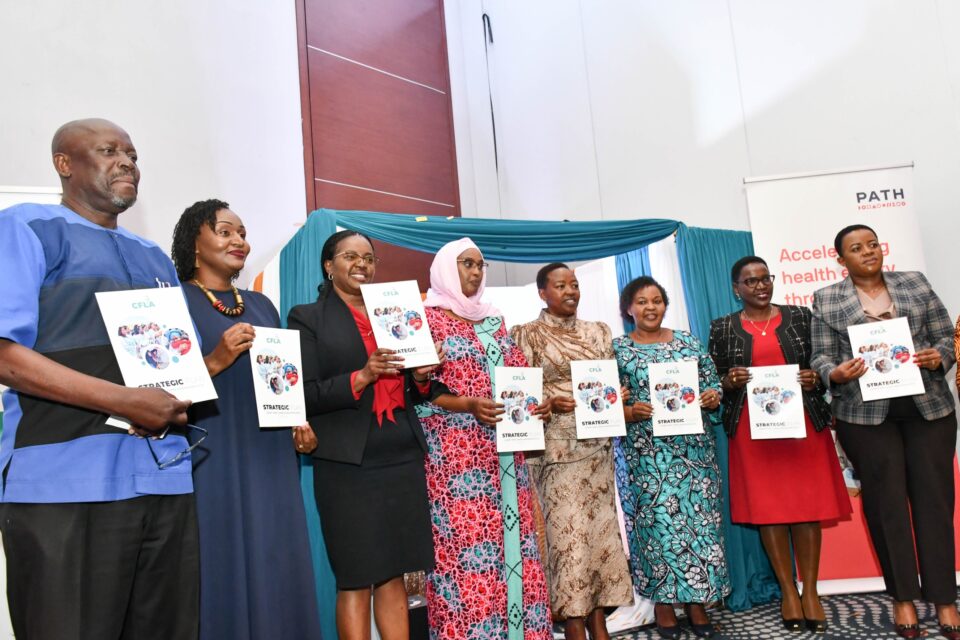
By George Morara
First Lady Rachel Ruto has lauded the gains made in the counties since devolution came into place, identifying the contributions made by the spouses of county governors.
Subsequently she called on stakeholders that embrace community development to support initiatives started by the county ladies in order to safeguard the numerous gains achieved in the last 11 years.
Speaking at the launch of the County First Ladies Association (CFLA) four-year Strategic Plan in Nairobi, Rachel noted that when institutions such as government agencies, private sector, development associates and philanthropists partner with the governors’ spouses, they are doing it with the 47 devolved units, and connecting with communities that trust them.
“Today, I invite you to walk with the County First Ladies, invest in them, and build with them, bearing in mind that the County First Ladies are not ceremonial but are strategic actors in Kenya’s development,” she said on Thursday evening, pointing out that the 2025-2028 plan is not for the county ladies alone; but also, for the country.
She explained why the partners are important in the implementation of the CFLA strategic plan, emphasizing that they are linked to a network that can mobilize faster, deeper, and more personally than any program.
The Plan outlines major interventions in health, education, gender equality, economic empowerment, and climate resilience across Kenya’s 47 counties.
She lauded the Association as a cornerstone for the general well-being of societies at the grassroots, pointing out that since its inception in 2014, at the advent of devolution, CFLA has ensured mothers, newborns, adolescents, and vulnerable groups received better care and dignity.
“You established EMPOWER Clinics in 18 counties, widening access to cancer screening and saving lives through early detection.
“You strengthened childhood development, equipping Early Childhood Development – ECD -centres, mentoring girls, and restoring hope where hope had been slipping,” Rachel said, showering her counterparts from the counties with more praises for transforming schools with kitchen gardens, school milk programs, and menstrual hygiene initiatives.
The President’s spouse noted that strategic plan represents the vision of a healthy, educated, and empowered communities. She said it does not stand apart from Kenya’s national development path; but strengthens it.
By advancing community health, driving economic empowerment, championing education and mentorship, confronting gender-based violence, and promoting environmental sustainability, the country’s First Lady said that her counterparts in the counties were strengthening the foundations of development.
“In doing so, you are not just supporting county priorities; you are powering Kenya’s journey toward a more dignified, prosperous, and equitable nation for all, in the process showing that leadership rooted in community is the most powerful of all,” she said.
Speaking as CFLA Chairperson, Marsabit County First Lady, Alamitu Jattani, said the 2025–2028 strategy aims to accelerate community-centered initiatives and strengthen county systems to uplift women, children, youth, and vulnerable groups. She described the plan as a bold, people-driven roadmap building on a decade of impactful county-level programmes.
“A major focus of the strategy is strengthening health interventions, particularly maternal and child health. CFLA will expand access to family planning, immunization, nutrition, and adolescent sexual and reproductive health services,” said Jattani.
She added that the plan prioritizes increased screening for cancer and non-communicable diseases through strengthened partnerships and community outreach. The Chairperson noted that the expansion of EMPOWER Clinics to 18 counties in the previous strategic cycle provides a strong foundation for scaling cancer screening and public awareness efforts nationwide. “Our goal is to ensure no woman, youth, or child is left behind,” she said.
The plan also outlines measures to enhance access to early childhood and primary education, particularly in underserved regions. Key priorities include enhancing mentorship programmes for young people, supporting school re-entry for teenage mothers, and renewing advocacy for girls’ participation in STEM and vocational training.
Initiatives such as school milk programs, kitchen gardens, and menstrual hygiene support—already implemented in several countries—will be expanded to boost school attendance and improve learner well-being.
As part of its gender equality agenda, the strategy commits to intensified action to eliminate harmful cultural practices, including FGM, child marriage, and widow disinheritance. It further calls for stronger advocacy and community engagement to tackle domestic violence, rape, femicide, and other forms of gender-based violence, while promoting cultural practices that uphold dignity and gender equity.
To strengthen economic empowerment, CFLA will scale up financial literacy programmes and entrepreneurship support targeting women, youth, and persons with disabilities. The plan envisions deeper collaboration with financial institutions to enhance access to microcredit and financing for small enterprises.
Recognizing climate change as a growing threat to community health and livelihoods, the strategy commits to promoting sustainable environmental practices and advocating for policies that reinforce climate adaptation. CFLA will mobilize communities for climate resilience initiatives and champion county-level frameworks linking climate and health.
Internally, the Association will focus on strengthening governance structures, succession planning, financial systems, monitoring and evaluation, and expanding the Secretariat to enhance programme implementation across all counties.
“Our strength lies in our unity across all 47 counties and in the partnerships that amplify our work,” said Jattani, urging partners to collaborate in the implementation of the strategy.
“We invite development partners, civil society, county governments, and the private sector to join us in empowering communities and building a thriving Kenya.”
