
A new report is showing a worrying trend of what Kenyans and other Africans should expect following the impact of Climate Change, warning of likely displacements and even migrations. Dubbed the State of Africa’s Environment report by Centre for Science and Environment (CSE), India, the report reveals that by 2050, up to five per cent of Africa’s population of some two billion people could be forced to be on the move due to climate change.
“Climate change-fuelled extreme weather events are already causing unprecedented displacement across the world. In Africa, rising sea levels, prolonged droughts, cyclones, and floods are expected to intensify, threatening livelihoods, food security, and access to water,” reads part of the report.
The report warns that without urgent adaptation measures and climate-resilient development, migration will not only strain already fragile economies but also heighten conflict risks as communities compete for scarce resources. “African governments and global partners need to scale up investment in climate adaptation, strengthen early warning systems, and prioritize support for vulnerable populations most at risk of losing their homes and means of survival,” says CSE Director General Sunita Narain. According to her, irrespective of the finance crunch, countries in Africa have the responsibility and the duty to take up immediate climate change adaptation measures.
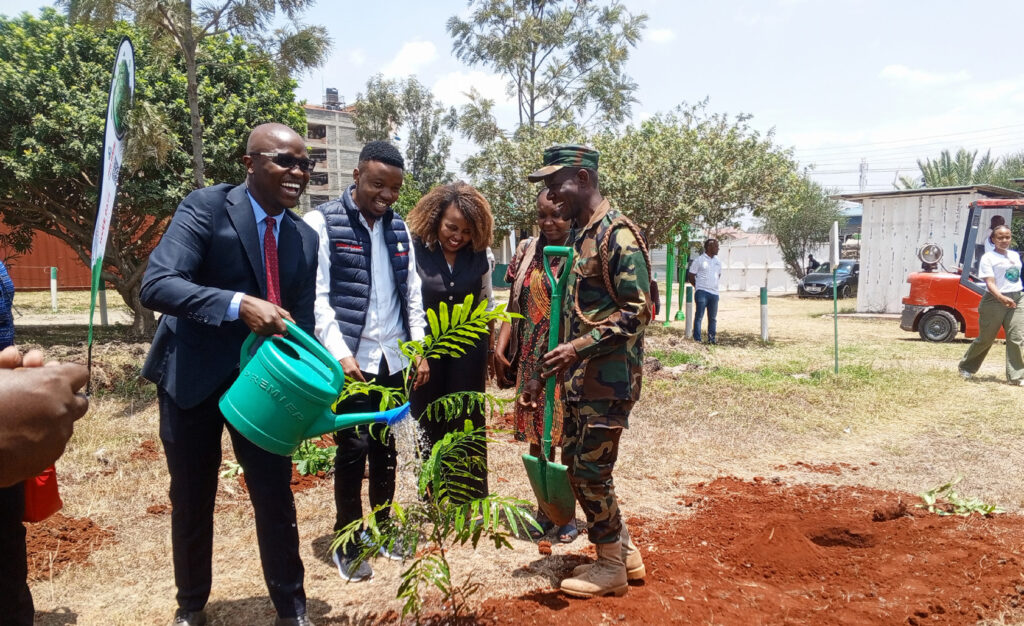
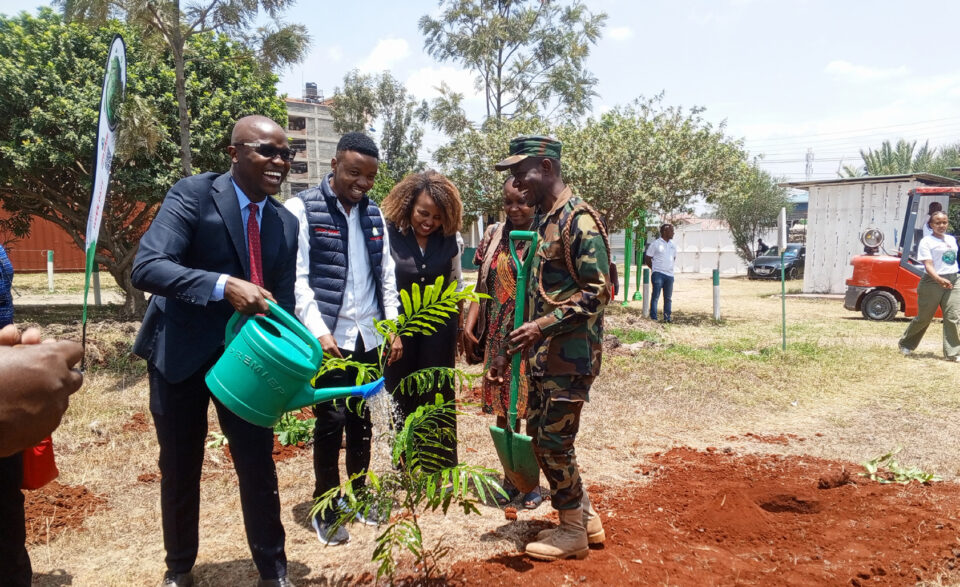
Arnold Kipchumba, the Director for Environment and Climate Action in the First Lady, Rachel Ruto’s office,
Mama Doing Good (l), assisted by Waste Electrical and Electronic Equipment (WEEE) Centre CEO, Bonnie
Mbithi waters a tree at the WEEE Centre during a tree planting exercise. PHOTO | GEORGE MORARA | TRBN |
FOOD SECURITY | Rising sea levels, prolonged droughts, cyclones, and floods are expected to intensify, threatening livelihoods, food security, and access to water
Reshaping Africa
According to the report, climate change is both figuratively and literally reshaping Africa. For decades, nations across the continent have struggled to move beyond colonial exploitation and violent conflicts. Just as many were finding their footing, the escalating challenge of climate change is threatening to undo hard-won progress. An analysis by Down To Earth magazine showed that between 2021 and 2025, more than 221 million Africans were affected by weather, climate, and water-related disasters. This was more than the combined total of the previous two five-year periods. Disaster-related deaths rose to nearly 29,000, more than triple the deaths recorded between 2016 and 2020.
Internal displacement in Africa has also tripled over the past 15 years. While conflict and violence remain drivers, extreme climatic events are playing an increasingly significant role. From 2009 to 2023, the number of people displaced by disasters increased sixfold. Floods alone accounted for more than 75 per cent of these displacements. In East Africa, 69 per cent of disaster displacements were caused by flooding during the March–May and October–December seasons. In West Africa, the figure was as high as 99 per cent.
“The good thing is across the continent, countries are adopting policy measures and crafting programmes to adapt to and mitigate climate change. From rolling out national strategies to become net-zero in carbon emissions to adopting indigenous knowledge against droughts and extreme weather, every African nation now has some adaptation programmes to showcase,” partshe said. Ethiopia, for instance, has integrated climate adaptation into its National Adaptation Plan, embedding resilience into development strategies. Africa is not alone in facing climate mobility. The UN’s World Migration Report 2024 estimates that more than 216 million people across six continents will be displaced within their countries by 2050 due to climate impacts. The International Organization for Migration projects that by 2050, some 200 million additional people could be classified as “environmental migrants.”
Epicenter of vulnerability
Still, Africa remains at the epicenter of vulnerability. The UN Environment Programme’s Navigating New Horizons report warned that climate-induced migration will disproportionately affect regions like Africa, Central America, the Pacific Islands, and South Asia. The Intergovernmental Panel on Climate Change (IPCC) recognizes migration as both a coping mechanism and an adaptation strategy. However, outcomes depend on whether migration is planned and supported, or forced and chaotic. Without adequate planning, migration in Africa could deepen poverty, strain fragile economies, and heighten conflicts over scarce resources such as land and water.
“Between 2021 and 2025, Africa experienced its deadliest climate crisis in decades. Droughts, floods, cyclones, landslides, cold waves, and heatwaves affected more than 221 million people. Droughts were by far the most significant, impacting 178 million people across the Horn of Africa and southern Africa. Ethiopia, the Democratic Republic of Congo, Nigeria, Somalia, and Sudan accounted for over half of those affected. Ethiopia alone recorded 33 million affected, a 17-fold increase compared to the previous five years. Libya witnessed catastrophic floods in Derna in 2023, killing more than 13,000 people — the deadliest weather disaster in recent African history.
Despite the grim outlook, experts stress that Africa also has unique opportunities. Speaking at the launch of the CSE report, Professor Kassahun Tesfaye, Director General of Ethiopia’s Bio and Emerging Technology Institute, argued that Africa’s natural resources could fuel a new model of sustainable development.
Change your thoughts, you change your world
Olam Agri, Agra ink deal to strengthen food and feed value chains in Africa
Olam Agri, a leading global agribusiness in food, feed and fibre, and AGRA, Africa’s leading partnership-driven institution for agricultural transformation, have entitled their future intention to jointly expand across Africa. They made the intention clear after signing a Memorandum of Understanding (MoU) intended to scale up sustainable food and feed value chains in Nigeria and Ghana. The MoU marks a crucial outcome from the Africa Food Systems Forum, 2025 hosted in Senegal, recently.
The collaboration will combine Olam Agri’s deep market presence and direct engagement with smallholder farmers and consumers with AGRA’s expertise in building inclusive, market-driven agrifood systems that improve food security, resilience, and livelihoods for smallholder farmers across the continent. Under the agreement, the two organisations aim to collaborate to: Scale smallholder farmer programmes in soy, wheat, maize, and rice in Nigeria, expand programmes for poultry and aquaculture farmers and scale baker initiatives in Nigeria and Ghana to improve food safety, nutrition, and profitability.
This proposed new collaboration aims at promoting inclusive and climate-smart agriculture, empower women and youth with new opportunities, strengthen market access and sustainability practices, and support smallholder farmers and SMEs through training, technology, and financial linkages, thereby enhancing their productivity, income, and resilience to market fluctuations. The MoU builds upon successful cooperation between the two organisations since 2021 in the rice value chain, where it supported over 5,000 smallholder farmers in the Niger state of Nigeria.
Saurabh Mehra, MD & Global Head, Food and Feed Processing and Value-Added Segment at Olam Agri, said, “Through this partnership, we will scale our sustainability projects with farmers and bakers in Nigeria and Ghana. As a leader in the food and feed value chain, we see this collaboration as strengthening our engagement and support for farmers and bakers to empower more local talent, strengthen food systems, and advance food security.”
“By combining AGRA’s catalytic capabilities and commitment to inclusive market systems with Olam Agri’s market access and technology, this partnership empowers African smallholder farmers and communities to thrive, ensuring fair opportunities, better livelihoods, dignified jobs for youth and a stronger, more resilient food system”, added Ms. Alice Ruhweza, AGRA President.
For the happiest life, days should be rigorously planned, nights left open to chance pennews wordpress theme
