
By Milliam Murigi
Africa must move beyond short-term, donor-funded digital agriculture projects and build sustainable financing models that enable proven solutions to grow, reach more smallholder farmers and continue delivering value long after programme funding ends.
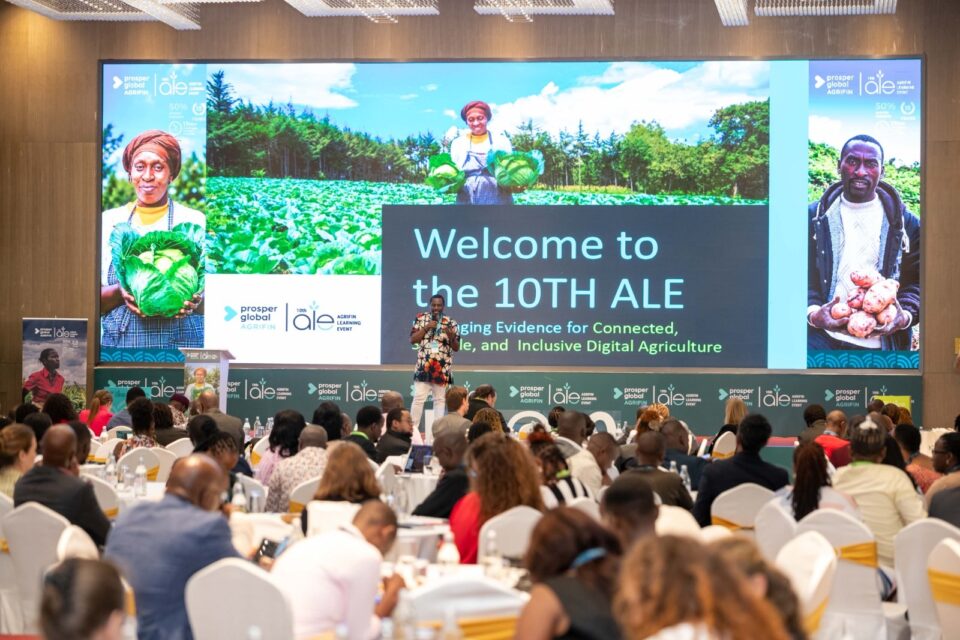
This was the central message at the 10th AgriFin Learning Event (ALE2026). Convened by Prosper Global AgriFin, formerly Mercy Corps AgriFin, the one-day forum brought together different stakeholder to examine how evidence can guide the next phase of digital agriculture across Africa.
Opening the event, Melaku Yirga, Vice President Africa at Prosper Global, challenged participants to look beyond individual projects and focus on the systems needed to sustain successful innovations.
“We’ve spent years testing ideas, building partnerships and learning what works. So the real question now is: how do we turn all of that into systems that can actually last and scale?” he said.
Since its establishment in 2012, AgriFin has worked to understand how digital technology, particularly mobile phones, can improve the lives and livelihoods of smallholder farmers. Its early work examined how mobile technology could support farmers in Africa and Asia, including through digital financial and information services.
In 2015, support from the Mastercard Foundation enabled the programme to investigate how digital agricultural innovations could be accelerated across Kenya, Tanzania and Zambia, markets with different levels of mobile ecosystem maturity. The experience helped inform approaches to supporting innovators delivering digital financial services and agricultural information to smallholder farmers.
A subsequent phase, supported by the Gates Foundation and the Bayer Foundation, among other partners, focused on taking proven solutions to scale across five African countries: Kenya, Ethiopia, Nigeria, Tanzania and Uganda. With a target of reaching five million smallholder farmers, the programme has surpassed that ambition, reaching more than 8.5 million farmers through digital information services, with women accounting for 41 per cent of those reached.
For Yirga, the next phase of agricultural development must build on these lessons, translating evidence into better decisions, stronger partnerships and investments that respond to the realities of farmers and markets.
“While digital services have expanded access to information and financial tools, investment in smallholder agriculture remains constrained by the risks and costs associated with serving fragmented rural markets,” he said.
Sieka Gatabaki, Program Director at Prosper Global AgriFin, said mobile technology has significant potential to improve farmers’ access to information and financial services, but adoption and practical value must remain central to scaling these solutions.
“We must incentivize farmers to adopt these digital tools like mobile money that holds key to broadening their revenue streams,” Gatabaki said.
He noted that technologies such as artificial intelligence could help farmers access information on changing weather patterns, agricultural practices and different sources of capital, while mobile platforms can support financial inclusion and make services more accessible in rural areas.
Gatabaki highlighted the challenges facing agricultural investment, including unpredictable weather, limited infrastructure, digital exclusion and the high cost of reaching individual smallholder farmers. These factors have historically increased the perceived risk of lending to or investing in agriculture.
“Digital technologies can help address some of these barriers by improving weather forecasting, extending access to agricultural advice and supporting more informed decisions. Better information can help farmers anticipate risks while giving service providers and investors a stronger basis for assessing agricultural opportunities,” said Gatabaki.
However, technology alone will not resolve these challenges. Solutions must be supported by trusted local relationships, appropriate infrastructure, accessible services and financing arrangements that make commercial sense.
As some existing programmes approach completion, Prosper Global AgriFin is positioning the next phase of its work as a transition towards new initiatives that build on the relationships, evidence and delivery systems established over the past decade.
Jasmina Lipovic, Global Finance Operations & Compliance Director at Prosper Global AgriFin, stressed that the end of a programme should not mean the end of the services and relationships it has helped establish.
“This is a transition, not an endpoint,” she said.
Lipovic explained that AgriFin had worked to establish strong relationships with banks, agribusinesses and technology companies so that digital services could continue reaching smallholder farmers beyond the initial funding period.
In response to a more constrained funding environment, the programme has also been adapting its operations, strengthening strategic partnerships and diversifying its programming and funding sources. The aim is to sustain quality service delivery while building on the progress made through existing programmes.
Elias Nure, Global Digital Climate Smart Agriculture Director at Prosper Global AgriFin, also underscored the need to strengthen public-private partnerships and make better use of the relationships that established organisations already have with farming communities.
Such partnerships can help connect farmers to public resources, data and information in formats that are easier to understand and use. They can also build on existing trust between farmers, service providers and institutions, reducing the barriers that often prevent new solutions from gaining traction.
“The wider challenge is to align public resources, private investment, technology and local delivery networks around shared outcomes rather than treating them as separate interventions,” said Nure.
Sheena Raikundalia, an innovation ecosystem leader, challenged participants to consider what happens when a project ends and how the wider system can continue supporting farmers.
Her presentation emphasised the need to connect the elements that make digital agriculture work: finance, infrastructure, technology, markets, farmers and the institutions that support them. Rather than investing only in individual innovations, stakeholders need to strengthen the relationships and systems that allow these components to work together.
Raikundalia also urged a practical approach to artificial intelligence and emerging technologies. Digital tools according to her should address real problems in farmers’ lives and respond to local needs, rather than being introduced simply because the technology is available.
This approach places the farmer at the centre of innovation, with success measured by whether solutions improve access to useful information, finance, markets and services and whether those benefits can be sustained.
