
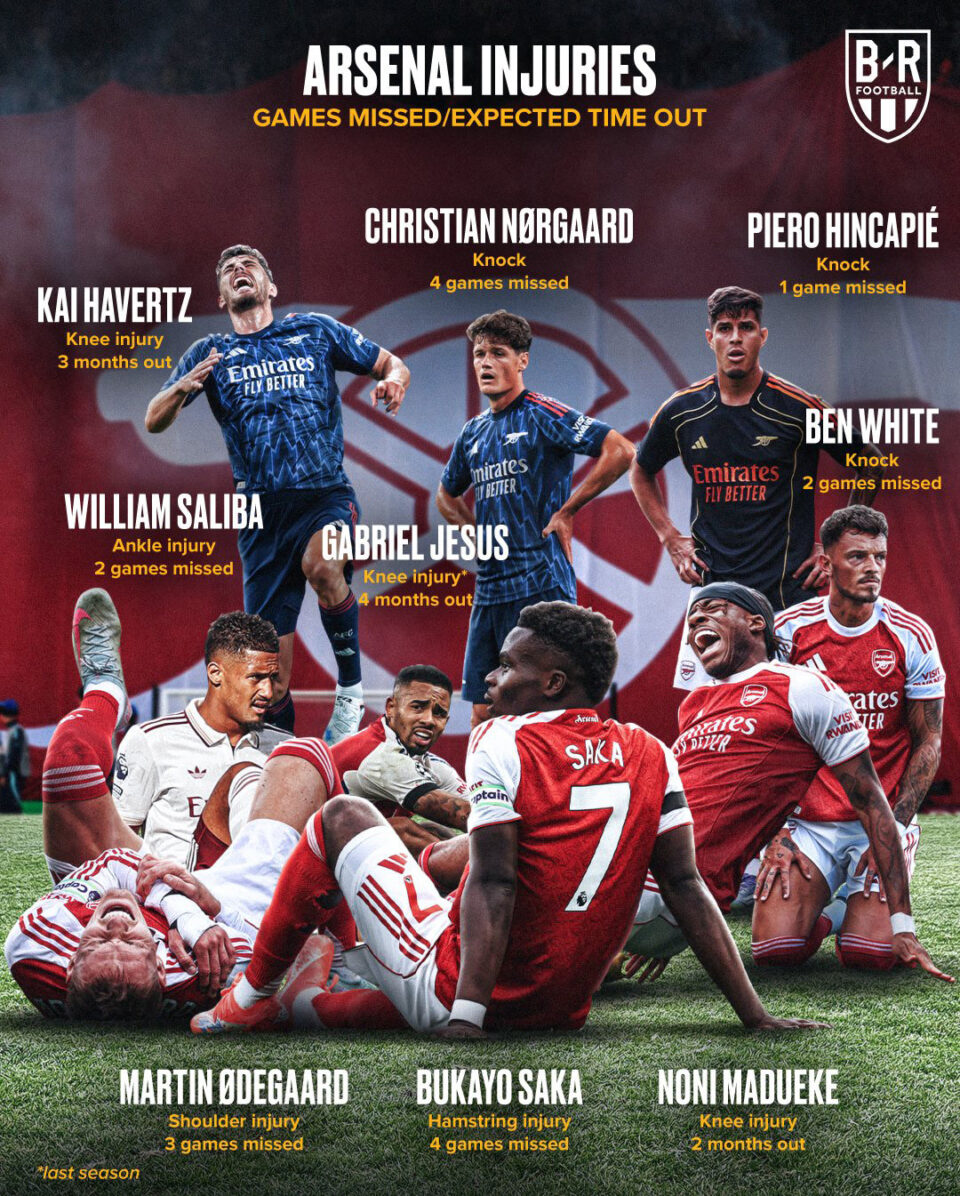
Arsenal are no strangers to an injury crisis, with perhaps the only surprise this latest edition being that it has come so early in the season. Already this term, Bukayo Saka, Martin Odegaard, William Saliba and Ben White have been sidelined with issues, while Kai Havertz is still yet to feature after undergoing minor knee surgery in late August. Gabriel Jesus, meanwhile, has not played since January. Noni Madueke joined the walking wounded last weekend, forced off at half-time against Manchester City.
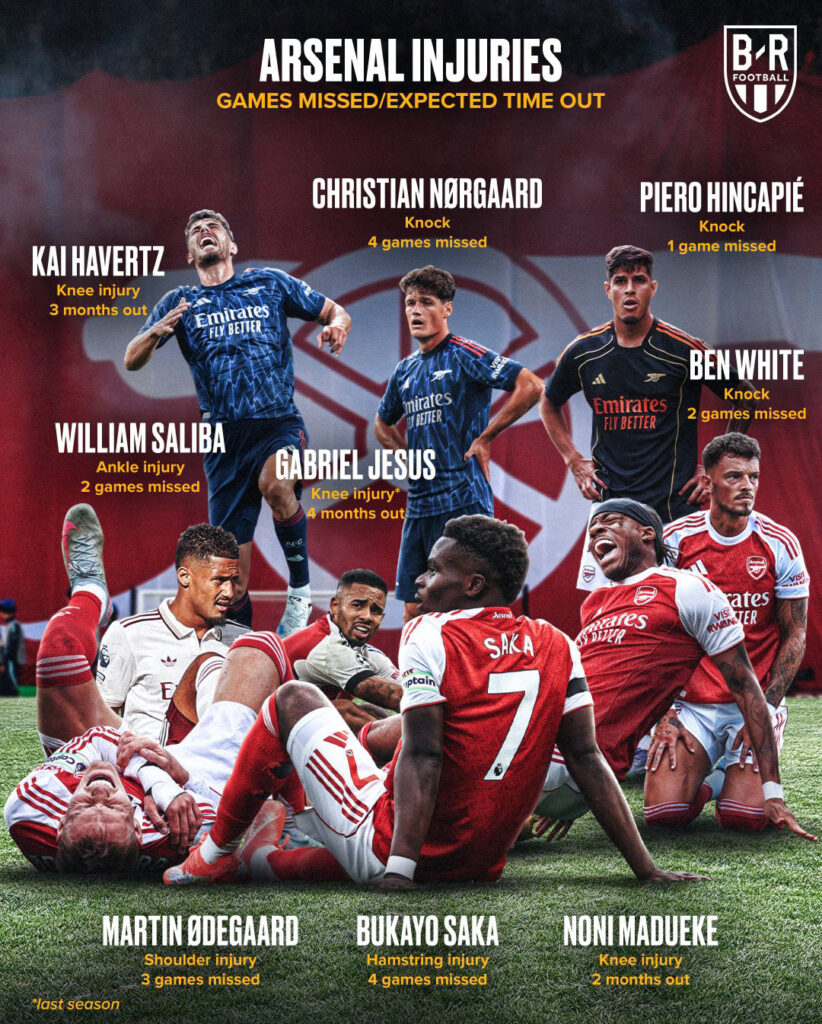
It could have been a lot worse. Saka’s hamstring injury was not as bad as first feared, and he returned on Sunday having missed just three games. While Odegaard has twice injured the same shoulder, he too has avoided the sort of damage that kept him sidelined for three months last season. Saliba was back in the side against City and again against Port Vale midweek, while Madueke’s knee injury is a medial ligament issue rather than an anterior one, with the former Chelsea winger now looking at up to two months out of action.
As Cristhian Mosquera, Martin Zubimendi and Madueke in particular have demonstrated, Arsenal now have the depth to navigate through these short-to-mid-term problems and remain undefeated this season. However, the frequency with which their fans are left sweating profusely over the fitness of their leading men remains a concern. Arsenal have well-documented struggles crossing the finishing line, and the absences of Saka, Odegaard, Havertz and Gabriel Magalhaes at crucial junctures last season played a major role in yet another trophyless campaign.
Given recent history, there might be a feeling that Arsenal have the worst luck in the Premier League. But in reality, Chelsea, Crystal Palace, Sunderland, Manchester City and Tottenham are currently dealing with the same number of injuries, if not more, during this period of the season where players are most at risk.
“What we are seeing is players come back in for the first few weeks of the new season and, in that time, we usually see a spike in injuries,” Stephen Smith, CEO and founder of Kitman Labs, which specialises in injury welfare and performance analytics, told Metro. “That is generally what we will see across the Premier League compared to other portions in the year. We see another spike around Christmas and New Year because there is so much congestion around that time period, and again towards the end of the season.”
When injuries start to stack up, inevitably questions arise over the causes. Blame can be directed at the medical staff, overly intensive training sessions, or players themselves failing to look after their bodies properly. Last season, Saka, Havertz, Gabriel and Martinelli were all struck down with hamstring injuries during the second half of the season in what became a league-wide issue as clubs battled through an unforgiving fixture schedule. This time around, Arsenal players have been struck by a variety of issues, a common problem at this stage of the campaign.
“If they were all suffering with a specific type of injury, it would be easier to jump to the conclusion that something is going wrong on the training pitch,” Smith said.
Could Israel be expelled from football competitions this week?
Since the United Nations Commission of Inquiry formally declared that Israel has committed genocide against Palestinians in Gaza, calls have intensified for the country to be suspended from international football competitions. Israel’s national team is currently competing in European qualifiers for next summer’s men’s FIFA World Cup, while Israeli club Maccabi Tel Aviv is playing in the Europa League.
According to the BBC, a senior figure at one football federation revealed that many nations are pushing for a vote on whether to expel Israel from European football, and UEFA’s leadership is reportedly inclined to act. On Friday, the Turkish Football Association demanded Israel be banned from football, while a group of 48 athletes signed a joint letter calling for the country’s suspension. The Times reports that a vote could take place as soon as next week, with Israeli Prime Minister Benjamin Netanyahu actively campaigning against it.
Meanwhile, the U.S. State Department has pledged to resist any attempt to bar Israel from potentially qualifying for the World Cup, which will be held predominantly on American soil.
Decisions on major issues in European football are made by UEFA’s executive committee, the governing body for the continent. This committee, comprised of 20 officials representing different member states, oversees UEFA’s governance, finances, and rules, and has the authority to vote on significant matters such as suspending a national association.
